Loading EasiMachines…


The purchase price of a used round baler is only the first number. Auctioneers who understand bale count, belt condition and wear-part replacement cycles can set realistic reserves and give bidders the information they need to model true ownership cost.
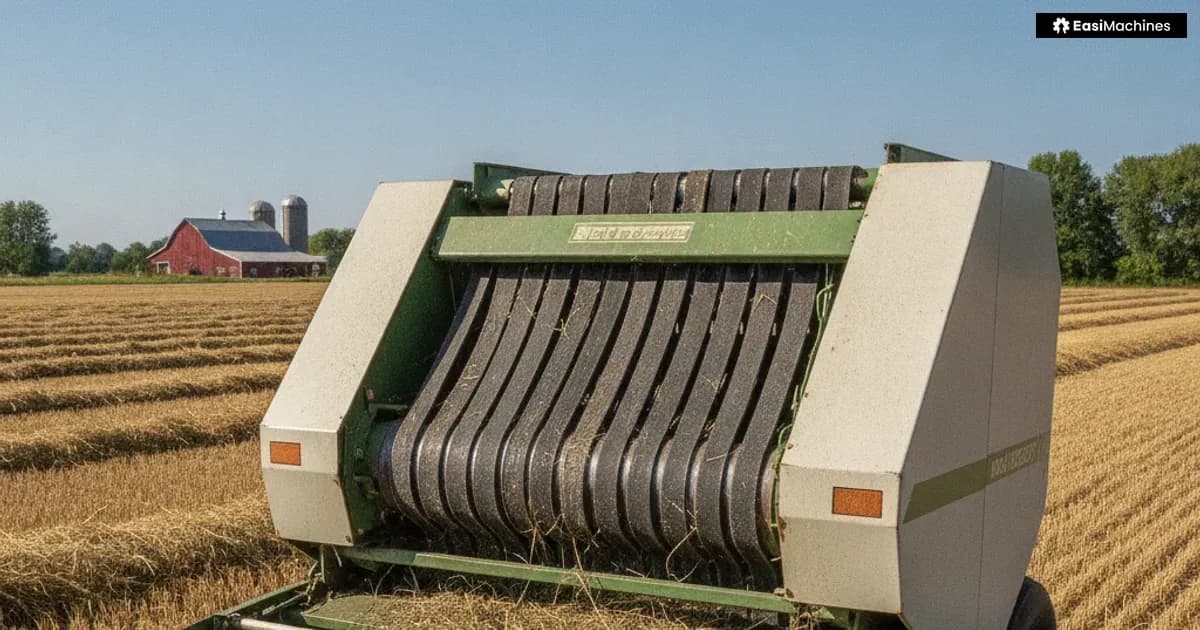
When a used round baler comes across the auction block, the hammer price settles the first number. The numbers that follow—fuel, wear-part replacement, downtime risk and eventual resale recovery—determine whether the buyer made a sound investment or an expensive mistake. This guide works through each cost component, explains what bale count signals about remaining life, and sets out what an auctioneer should disclose—and ask the consignor to supply—before the lot goes live.
A round baler's mechanical wear is driven primarily by throughput—bales produced—not calendar years. Belts, pick-up tines, chains, rollers and the twine-tie system (knotter) or net-wrap system all accumulate wear in direct proportion to how many bales have passed through the machine. A three-year-old baler used intensively by a contractor may be close to its first major rebuild. A ten-year-old baler used lightly by a small mixed farm may have years of reliable life left.
If the consignor can supply a bale counter reading—many modern electronic monitors record cumulative bales—treat it the same way you treat engine hours on a tractor: the primary utilisation signal. Where no bale counter is fitted or the reading is unavailable, the next-best evidence is a maintenance log showing belt replacements, roller refurbishments and pick-up work. Records may be unavailable on older or estate machines through no fault of the consignor; in these cases, the reserve should reflect the uncertainty buyers will apply, not an assumption of neglect.
Before the lot goes live
Ask the consignor for the bale counter reading, the most recent belt inspection record and any roller or chain replacement invoices. Photograph the belts in daylight from both sides of the baler, and photograph the knotter or net-wrap system with the cover open. These four items answer the questions every serious bidder will ask.
Breaking ownership cost into four components makes it easier to explain to bidders and to structure the lot description.
The hammer price is the entry point. For buyers financing the purchase, interest cost over the ownership period adds to the effective price. Share the link to the cost-of-ownership calculator with bidders so they can enter their own figures—purchase price, expected annual bale output, local belt and twine or net-wrap costs, and financing rate—and generate a multi-year estimate. It is an estimate, not a quote, but it anchors the conversation between auctioneer and bidder on the same set of numbers. This is especially useful when buyers are comparing two lots in the same sale.
A round baler is tractor-powered via the PTO (power take-off), so its running cost shows up in the tractor's fuel burn during baling. The relevant figure for buyers is tractor fuel per bale, which depends on crop type, bale density setting, field conditions and tractor match. This varies enough between operations that no single figure is reliable; buyers should use their own tractor's known consumption as the baseline.
Twine or net wrap is a significant recurring consumable cost. Cost per bale varies with bale size, wrap type, the number of twine turns or net-wrap revolutions required, and local supplier pricing. Including the consignor's typical wrap type and bale size in the lot description gives buyers a basis for their own consumable estimate. Where the consignor can speak to crop type and typical baling rate achieved, include that in the lot description as a cross-check against buyers' own conditions.
This is where round baler ownership cost diverges most sharply between machines that look similar at the time of sale. The main wear components are belts (on variable-chamber machines), pick-up tines, pick-up drive chain, cam track and cam followers (where fitted, on models using cam-driven tine carriers), tine finger guides, pick-up gearbox, roller bearings, chains and sprockets, PTO driveline components, and the knotter or net-wrap system—including, on net-wrap machines, the film tension and brake system.
Understanding the chamber design is essential before prioritising the inspection. Variable-chamber balers use belts as the primary chamber-forming element; belt condition is the dominant wear-part focus on these machines. Fixed-chamber balers—sometimes called hard-chamber balers—form the bale using a fixed set of steel rollers. Some hybrid designs combine a fixed roller arrangement with belts, but confirm the specific forming elements from the manufacturer's specification for the model before inspection; do not assume. On variable-chamber machines, belts that are cracked, delaminating, tracking unevenly or showing visible wear patches signal an imminent replacement cost. On a machine with several belts, a full set replacement can represent a material portion of the machine's resale value—buyers will want to price that in before bidding. On fixed-chamber machines, focus on roller bearing condition and chain drive wear. Confirm whether the machine has been converted to net wrap or remains twine-only, since each system carries its own service requirements.
Practical threshold for near-term repair cost
On a variable-chamber baler, a full belt set can represent a material portion of the machine's auction value—the proportion varies with model, parts pricing and local demand. When estimated wear-part costs approach or exceed a significant share of the expected hammer price, that is a signal for buyers to reassess their bid ceiling and for auctioneers to revisit the reserve. The cost-of-ownership calculator at /resources/tco-calculator allows buyers to enter their actual quoted parts cost and purchase price to test this relationship with their own numbers.
Chain and sprocket wear is best assessed by checking chain slack against the manufacturer's service specification. Loose chain on the pick-up or bale-forming drive is a wear signal that runs ahead of visible damage. The bale density system—whether hydraulic cylinders, density springs or pressure settings depending on the model—is also a maintenance item; check for hydraulic leaks and confirm the system reaches and holds the specified density setting. The PTO driveline is another common wear point: check the universal joints for play, confirm the shear bolt or slip clutch is serviceable, and verify that all driveline guards are present and intact. Driveline failures are both a maintenance cost and a safety hazard.
On twine-tie machines, knotter condition is assessed by running the machine through a tying cycle to verify that twine feeds, knots and cuts cleanly.
Safety requirement: knotter and net-wrap testing
Any operational test of the knotter or net-wrap mechanism must be performed by the consignor or a qualified technician—not by the auctioneer or a prospective bidder. The machine must be connected to a tractor with the operator in the seat, all guards in place and bystanders clear of moving parts, in accordance with the manufacturer's prescribed safe operating procedure. These mechanisms are a known entanglement hazard on balers.
The tailgate (rear door) latch and hinge condition is safety-critical: a failed latch during operation can cause bale ejection. Check that the latch engages positively, that hinges show no cracking or distortion, and that any safety interlock tied to the tailgate is functional. Note the condition in the lot description.
Undisclosed belt condition is the most common source of post-auction disputes on round balers
If the consignor is unable to provide belt photographs with both sides visible, note that in the lot description. Bidders will discount accordingly, but they will not be misled—and you will not carry the dispute.
Round balers depreciate with use, but they also hold value in markets where parts support is strong and the brand is well represented in the local dealer network. A machine with documented low bale count, a full set of recently replaced belts and clean service records typically commands a premium over an identical model with no history—because buyers' risk is measurably lower.
When setting a reserve, consider not just today's market price but the realistic resale value at the end of the buyer's planned ownership period. A machine bought at a reasonable price and maintained well may recover a meaningful share of its purchase price at resale. A machine bought cheaply but requiring immediate belt and roller work may cost more in total than a better-maintained lot sold at a higher hammer price. The valuation tool can provide a directional price range where market evidence supports one; it is not an appraisal and not a transaction price.
The table below illustrates how cost components differ between two otherwise similar machines. No specific figures are given because they depend on model, region and local parts pricing; the purpose is to show which components shift and by how much, qualitatively.
| Cost component | Low-use machine (documented low bale count, service records) | High-use machine (high or unknown bale count, no records) |
|---|---|---|
| Purchase price | Higher hammer price expected | Lower hammer price expected |
| Immediate wear-part risk | Low — belts or rollers, chains likely serviceable | High — budget for belts or rollers, chains, pick-up work before first season |
| Consumable cost (twine or net wrap) | Same per bale as high-use (wrap type and bale size dependent) | Same per bale, but downtime risk raises effective cost per bale |
| Fuel/running cost | Determined by tractor and crop, not machine use-history | Same per bale, but higher downtime risk increases cost per productive bale |
| Planned maintenance cost over 2–3 seasons | Lower — rebuild cycle further away | Higher — rebuild likely within first or second season |
| Downtime risk | Lower — fewer near-term failure points |
An auctioneer managing a consignment sale is not an inspector, but the information the consignor supplies—or does not supply—shapes the lot's credibility and its final price. Records may be absent on older or estate machines through no fault of the consignor; this is common and does not imply neglect. The auctioneer's job is to describe accurately what is known and to state plainly when it is not available.
Where the consignor cannot supply records, state that in the lot description rather than leaving it blank. Bidders interpret a blank field as either an oversight or an omission; a plain statement that records are unavailable is more credible and reduces the risk of a post-sale dispute.
The printable inspection checklist covers round balers by category and can be shared with the consignor to gather the right details before the listing is drafted. It supports, and does not replace, an inspection by a qualified person.
A consignor will often present a machine at its best and expect a reserve based on its asking-price equivalent. The auctioneer's job is to anchor the reserve to what a well-informed bidder will pay, given the disclosed condition.
If the belts are near the end of their service life and that is disclosed, the reserve should reflect the cost buyers will need to replace them. If bale count is unavailable, the reserve should reflect the uncertainty premium buyers will apply. Neither adjustment is a penalty on the consignor—it is an accurate reading of what the market will bear once buyers can see the condition clearly.
Where the consignor has documentation showing low bale count and recent maintenance, the auctioneer can defend a higher reserve with evidence. That evidence is worth gathering before the listing goes live. Use the valuation tool for a directional price range, then apply your own knowledge of local demand and comparable lots.
Finding comparable listings
If you need to track market availability for a specific model—for reserve-setting or to advise consignors on current supply—a saved search on EasiMachines can email you when new matching listings appear. Browse current agricultural machinery listings at /equipment?industry=agricultural-machinery.
Presenting cost information clearly helps the right buyers self-select. A buyer with a low annual bale requirement and no immediate season pressure can absorb a machine needing belt replacement if the price reflects it. A contractor who needs the machine operational from day one of harvest cannot.
The lot description should give each type of buyer what they need to make that call. State the bale count or its absence, state belt and knotter or net-wrap system condition, state what records are available. Let the cost components do the work.
Share the cost-of-ownership calculator with bidders
Before the lot goes live, share the link to the cost-of-ownership calculator at /resources/tco-calculator with prospective bidders alongside the disclosed figures: purchase price, expected annual bale output, local belt and twine or net-wrap costs, and financing rate. Bidders who arrive at the tool with those numbers prepared can generate a multi-year estimate quickly. It is an estimate, not a quote, but it moves the conversation from guesswork to disclosed cost components.
Look at the maintenance records. A dated invoice for belt replacement gives a minimum bale count from that point forward if you know the operation's typical seasonal output. Failing that, inspect the belts (on variable-chamber machines), roller bearing condition (on fixed-chamber machines), pick-up tines, pick-up drive chain slack, and cam track and cam followers (where fitted) directly — their wear state relative to the machine's age gives an experienced eye a reasonable read on throughput. Note in the lot description what evidence was available and what was not.
Variable-chamber balers use belts as the primary forming element, making belt condition the dominant wear-part inspection point. Fixed-chamber balers form the bale using a fixed set of steel rollers; on these machines, focus shifts to roller bearing condition and chain drive wear. Some hybrid designs combine a fixed roller arrangement with belts — confirm the specific forming elements from the manufacturer's specification before comparing costs. Both designs wear the pick-up drive chain, tine finger guides and the knotter or net-wrap system at broadly similar rates relative to throughput. Any cost difference between designs depends on the specific model and its maintenance history.
Where the consignor's records are limited or the machine is high-value, a pre-sale inspection by a qualified person adds credibility to the lot and can support a higher reserve. The cost of the inspection is typically borne by the consignor or recovered in the final hammer price. A written inspection report attached to the lot description reduces buyer uncertainty and reduces the risk of a post-sale dispute. Find inspection services through the EasiMachines services directory at /services.
Parts availability affects both the cost per repair and the downtime risk between ordering and receiving parts. A model with strong dealer network coverage and readily available belt sets, knotter components or net-wrap system parts will cost less to maintain in practice than a machine where parts must be sourced overseas or on extended lead times. When evaluating a lot, ask the consignor which dealer they used for parts and whether any components proved difficult to source. That information is worth including in the lot description.
Disclaimer: The buying and selling guidance in this article is based on EasiMachines' own experience and research. It is general information, not professional, legal or financial advice. Use your own judgement and carry out your own due diligence before you buy or sell; EasiMachines is not responsible for any loss or damage arising from decisions made without that due diligence. EasiMachines is independent and is not sponsored by, affiliated with or endorsed by any manufacturer or brand named in this article. Brand names and trademarks belong to their respective owners and are used only to identify products. Check current specifications with the manufacturer.
About the author
The EasiMachines Editorial Desk
EasiMachines Editorial Desk
The EasiMachines Editorial Desk publishes practical guidance for industrial machinery buyers, sellers, dealers, manufacturers and auction houses on sourcing, inspection, pricing and selling. It is general guidance, not a certified inspection, appraisal or legal advice: verify specifications and condition with the manufacturer or a qualified inspector. Corrections and practitioner input are welcome via the contact page.
| Higher — worn components more likely to fail mid-season |
| Resale value at end of buyer's ownership | Higher — provenance maintained | Lower — further depreciated, harder to document condition |
| Total cost of ownership over 2–3 seasons | Often lower despite higher entry price | Often higher despite lower entry price |
Yes. Net wrap generally costs more per unit than twine but typically requires fewer wrapping cycles or revolutions to achieve a secure bale and can produce a more weather-resistant bale for some crops. Twine-tie machines have a lower consumable unit cost but higher knotter service requirements. Net-wrap machines add the film tension and brake system as a wear and maintenance item. The right comparison depends on bale size, crop type, storage conditions and local supplier pricing. Including the consignor's typical wrap type in the lot description lets buyers run their own consumable cost estimate.