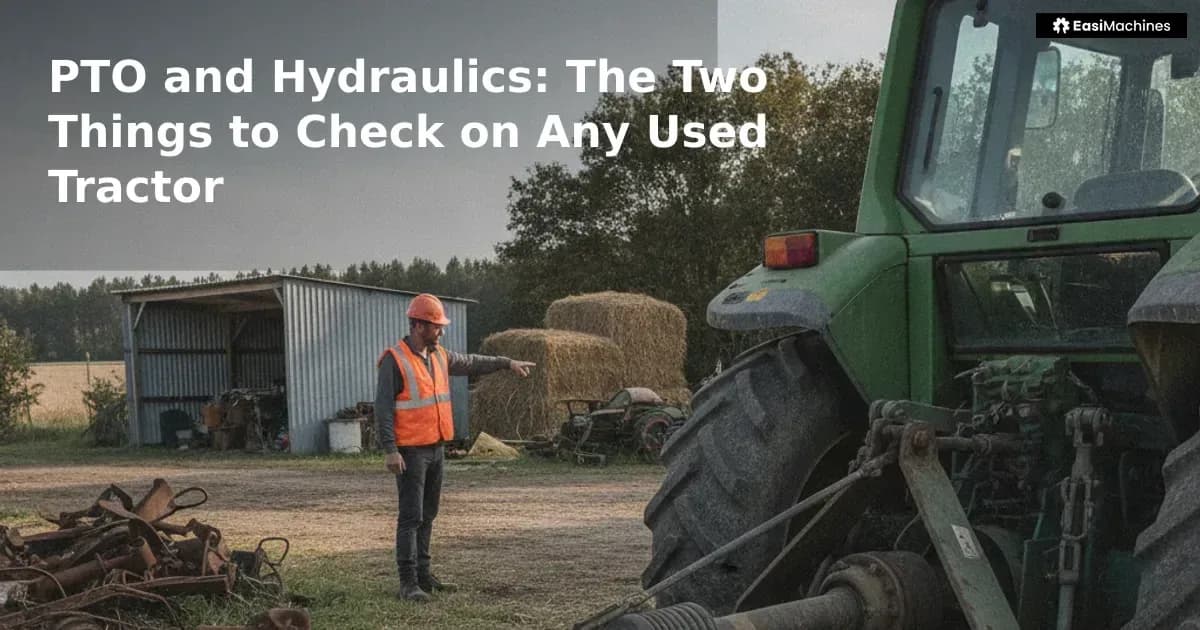
Checking the PTO
The PTO is the rotating output shaft — typically at the rear of the tractor, sometimes at the front — that drives attached implements directly. Standard speeds are 540 rpm and 1,000 rpm, and most tractors with dual-speed PTO will have a selector for both. Before you touch anything, confirm the tractor is off, in neutral, and the PTO is disengaged. Then do the following checks in sequence.
- Spin the PTO stub shaft by hand with the tractor off. It should rotate smoothly with slight, even resistance from the internal clutch pack. Rough grinding, catching, or no resistance at all (the shaft spins completely free) all indicate internal wear.
- Check the stub shaft splines — the ridged teeth the implement coupling slides onto — for wear. Rounded or burred spline tips mean the shaft has been coupled and uncoupled repeatedly under load, which accelerates wear on any implement you attach.
- Start the tractor and engage the PTO at low throttle. Engagement should be progressive: a brief pause, then a smooth pickup of speed. A sharp jerk or loud clunk on engagement points to a worn clutch pack or a failing engagement brake that is supposed to hold the shaft stationary during coupling.
- Rev the engine to the rated operating speed for the PTO speed you are testing (typically 1,900–2,100 rpm for 540 rpm PTO on most older tractors; check the operator manual for the specific model). Listen for any vibration or speed variation at the shaft — inconsistency under load suggests clutch slip.
- Disengage the PTO at the same operating speed. It should stop within 7 seconds on most modern tractors (some manufacturers specify shorter stop times for safety compliance). A shaft that coasts freely for much longer has a worn or absent PTO brake — a safety issue and a sign of neglect.
- If the tractor has an independent PTO (one that operates regardless of ground speed or clutch pedal position), confirm this by pressing the clutch pedal while the PTO is engaged: the shaft should keep spinning. On a live PTO, the shaft should keep spinning with one clutch depression but stop on a full double-depression. A non-independent PTO that the seller describes as independent is a straightforward misdescription.
- Ask to see the PTO output after 10–15 minutes at working temperature. Oil seals around the shaft housing commonly weep when they expand with heat. A few drops over a long session may be manageable; a steady drip means a seal replacement job before the machine goes to work.
Checking the Hydraulic System
The three-point linkage (3PL) — the pair of lower lift arms and the top link at the rear of the tractor — is operated by the hydraulic system. This system also feeds any remote hydraulic circuits connected to external implement rams. Problems here range from slow or weak lift response to full hydraulic failure, and they can stem from the pump, the control valve, worn lift cylinder seals, or simple low fluid. The checks below apply to the rear linkage and to remote circuit operation.
- Check the hydraulic fluid level and condition before starting. The fluid should be at the marked level on the sight glass or dipstick, and it should be clear amber or light red depending on the fluid type specified. Dark brown, milky, or gritty fluid signals contamination or overheating history — both shorten pump life.
- With the engine at idle, raise the three-point linkage to its full height using the position control lever. It should lift smoothly and reach the top of its travel. Time the lift from lowest to highest position: most agricultural tractors should complete a full rear lift in 3–5 seconds at rated flow. Significantly slower than that at idle is worth testing again at operating rpm; if it remains slow, suspect pump wear or a partially blocked filter.
- Hold the linkage at full height for two minutes with the engine idling. Lower drop during this hold test — more than roughly 20–30 mm on a standard linkage — indicates worn or bypassing lift cylinder seals. Minor internal seep is common on older machines; sustained drift under a loaded implement will cause implement height creep during fieldwork.
- Lower the linkage fully and then raise it against a load if possible. The easiest field test is to hook a filled front bucket, heavy ballast weight, or a loaded implement to the lower links before lifting. The hydraulics should handle rated implement weight without the lift speed slowing dramatically or the pump audibly straining.
- Check the draft control response if the tractor has it — this is the system that automatically adjusts implement depth based on soil resistance, rather than requiring the operator to raise and lower manually. Move the draft control lever through its range while the linkage is loaded. The linkage should respond by rising or falling within a second or two of lever movement. No response, or only partial response at one end of the range, points to a sticking or worn draft control valve.
- Test any remote hydraulic couplers — the flat-face or ball-type connectors on the rear of the tractor that feed external implement rams — by connecting a test line or a known-working implement and cycling the remote valve lever. Flow should be immediate and consistent in both extend and retract directions. Weak flow on one circuit only usually means a faulty spool valve for that circuit, not a pump problem.
- Inspect the hydraulic hoses and the area around the ram and spool valve body for oil weeping. Run your hand along the underside of hoses with the system pressurised (take care not to hold a bare hand directly over a suspected leak — pressurised hydraulic fluid penetrates skin). Damp, oily dust accumulation along a hose run is a reliable indicator of a slow leak that the seller may not have flagged.
A used tractor does not need to pass every check perfectly to be a reasonable purchase. What these checks give you is a costing basis. A PTO clutch pack replacement is a known job with a known parts and labour cost; if you identify it before purchase, you negotiate it out of the price or budget for it explicitly. A hydraulic pump replacement on a mid-range utility tractor typically costs more than a PTO seal job — knowing which problem you are looking at tells you whether the price gap between this machine and a cleaner one is worth closing.
If both systems perform well across all the checks above, you have reasonable grounds for confidence in the mechanical condition of the tractor's working systems. If either system shows multiple symptoms — not just one — treat that as structural wear rather than a single component issue, and factor in the cost accordingly. A tractor with a slipping PTO clutch, a weeping shaft seal, and slow hydraulic response that also drifts under load has not had its working systems maintained. That pattern matters more than any individual symptom.
One practical step: bring a mechanic or an experienced operator with you for any tractor above your own experience level. Sellers expect it, and a second pair of hands on the PTO shaft and the linkage levers makes several of these checks faster and safer. If you are buying remotely and cannot arrange an inspection yourself, request a short video of the PTO engagement and the hold test — not a walk-around video, but a specific demonstration of these two checks. A seller who refuses to run those tests on camera without a clear reason is telling you something.
Where EasiMachines Helps — and Where It Does Not
EasiMachines lists used tractors with specification details and seller contact information, which helps you identify and compare machines before travel. When a listing includes photos or video, request that the seller add footage of a live PTO engagement and a linkage hold test if those are absent — EasiMachines' messaging tools let you do that directly from the listing. The platform can assist you in finding machines and reaching sellers; it does not independently verify mechanical condition, and no automated valuation replaces the hands-on checks described above. There is no established EasiMachines inspection service that completes a PTO or hydraulic assessment on your behalf, so treat the physical visit as non-negotiable for any serious purchase.
Frequently asked questions
Can I check the PTO and hydraulics without attaching an implement?
You can run most of the PTO checks — engagement quality, stop time, shaft spin — without an implement. The hydraulic hold test and load-bearing checks are more revealing with a loaded implement attached, even a ballast weight, because they expose problems that only appear under pressure. An unloaded linkage can lift and hold fine while leaking past cylinder seals whenever actual implement weight is applied.
How much hydraulic drift during the hold test is acceptable on an older tractor?
There is no universal published standard that applies to all tractors, and acceptable drift depends on the machine's age and the work you plan to do with it. As a practical guide, more than 30 mm of drop over two minutes at idle — without any implement weight on the linkage — warrants further investigation. On a tractor you plan to use for precision work such as planting or spraying at consistent implement depth, even moderate drift will cause problems. On a machine used for heavy cultivation where linkage position is adjusted constantly anyway, it is a lower-priority concern.
The seller says the PTO jerks on engagement but is 'normal for this model.' Is that true?
It is possible for certain older tractor models to have stiffer or less progressive PTO engagement than modern designs. However, a sharp jerk or loud clunk on engagement is not normal on any well-maintained machine, regardless of age. If you want to verify the claim, look up the operator manual or a model-specific forum for the tractor in question before your viewing. Do not accept 'normal for this model' without being able to confirm it independently.
Does dark hydraulic fluid always mean serious problems?
Not always, but it means the service history needs scrutiny. Hydraulic fluid darkens with heat cycling over time and with contamination from internal wear particles. Dark fluid alone is not a condemnation — the fluid may simply be overdue for a change, which is a low-cost service item. Milky fluid (water contamination) and gritty fluid (metal particles) are more serious because they indicate either a seal failure allowing water ingress or active metal wear inside the pump or valve body. If you see either of those, request a service history and factor in a full hydraulic flush and potentially a pump inspection.
I am buying a tractor to run a PTO-powered generator or pump, not fieldwork. Do the same checks apply?