Preparing a used tractor for sale
Documents and records tractor buyers ask for
- Ownership: the purchase invoice and, where tractors are registered, the registration document in your name (in India, the RC). Mismatched names or chassis numbers stop serious buyers.
- Finance: written confirmation that no finance is outstanding, or a settlement letter showing how it will be cleared at sale.
- Service history: dates and hours of engine, transmission and hydraulic oil and filter changes, ideally with invoices.
- Major repairs: what was done to the clutch, PTO clutch, transmission, front axle or engine, when, at what hours and by whom.
- Diagnostics: on electronically controlled tractors, a recent dealer printout of active and stored codes and controller hours, including PTO hours where recorded.
- After-treatment: on Tier 4 Final, Stage IV and Stage V tractors, the DPF regeneration or cleaning record and any SCR (AdBlue/DEF) or EGR repairs. Buyers ask because these systems can derate the engine when they fail.
- Guidance and ISOBUS: a list of receivers, displays, steering components and activations with serial numbers, and what transfers.
- Manuals and keys: operator’s manual, spare keys, and any toolbox or fuel cap keys.
Cleaning
Blow out the radiator, intercooler, oil-cooler and air-conditioning condenser stack first, because a chaff-blocked cooling pack makes a buyer suspect overheating. Then wash the tractor, including the underside of the cab and the hitch area, a few days before photos so it can dry and any fresh leaks can be seen. A tractor washed minutes before a viewing can look as if it is hiding leaks. Clean the cab glass, seat and floor and empty the cab. Do not use high-pressure water directly on electrical connectors, seals or the alternator.
Fix or disclose
- Usually worth fixing: overdue service, leaking hydraulic couplers, missing PTO shield, broken lights and mirrors, missing linkage pins and lynch pins, a flat battery.
- Decide case by case: tyres, seat, cab air-conditioning, worn loader pins.
- Usually disclose rather than repair in a hurry: clutch, transmission, front axle or engine faults. A rushed repair without records can raise more questions than it answers.
Write down every known fault and share it before the viewing. A fault the buyer finds that you did not mention damages trust in the rest of the description.
Demonstrating it running and under load
Many buyers ask for the tractor not to be started before they arrive, so they can see a cold start. Plan a demonstration that a trained operator carries out:
- Cold start, then idle while the buyer watches the exhaust and listens.
- Hitch lift and hold with a suitable implement or weight, everyone clear. Experienced buyers leave a mounted implement raised for several minutes to see whether it creeps down, which points to leakage in the lift circuit.
- Each remote valve extended, retracted, held and floated, and any Power Beyond or free-return couplers identified.
- PTO engaged at each speed with nothing connected and everyone well clear. After switch-off the PTO brake should stop the stub promptly; a stub that keeps turning suggests a dragging PTO clutch.
- Drive through the gears or powershift steps, shuttle, 4WD and diff lock, and brakes.
- Ideally, a short run with a real implement such as a cultivator or PTO machine.
Pricing a used tractor
Tractor prices move on model generation, hours read alongside age, transmission and hydraulics, front axle and options, tyres, guidance and loader, emissions stage, region and season. How buyers read hours is set out in Tractor Engine Hours, and how they weigh new against used in the Used Tractor Buying Guide. Compare like with like:
- Find listings for the same model and generation in your country or region, in a similar hours band.
- Note each one’s transmission, front axle, hydraulics, loader, tyres and guidance.
- Look for completed auction results, which show what buyers paid rather than what sellers asked.
- Adjust for your tractor’s differences, both up (new tyres, recent clutch, extra remotes) and down (worn tyres, a known fault).
- Set an asking price inside that range with room for negotiation, and decide your lowest acceptable figure before the first call.
Where the controller logs PTO hours separately, state them next to engine hours. Buyers compare the two to see whether the tractor mostly drove mowers, balers and other PTO machines, or did haulage and loader work, and they price wear on the PTO clutch, brakes and front axle accordingly.
Timing matters with tractors. Demand for some types rises before planting or harvest, and more tractors come onto the market after harvest; The Best Time to Buy a Used Tractor describes the buyer’s side of this. Decide what the price includes (loader, weights, front linkage, guidance) and state it.
Writing the listing
Specifications to state
| Item | What to state |
|---|
| Identity | Make, model, year of manufacture, chassis and engine serial numbers (or partial numbers until a serious enquiry) |
| Hours | Engine hours, and PTO hours if recorded; whether the meter or dash has ever been replaced |
| Power | Rated engine power as published by the manufacturer, and the standard it is quoted to where known |
| Transmission | Type (manual, power shuttle, partial or full powershift, CVT) with the maker’s own name for it where it has one (for example AutoPowr, CMATIC, CVXDrive, Dyna-VT or Vario), top speed (for example 40 or 50 km/h), creeper |
| Front axle | 2WD or MFWD, front axle suspension, front linkage and front PTO |
| Hydraulics | Pump type, number of remotes, Power Beyond, hitch category, electronic or mechanical hitch control |
| PTO | Speeds available (540, 540E, 1000, 1000E) and stubs included: commonly 1 3/8 in 6-spline for 540, and 1 3/8 in 21-spline or 1 3/4 in 20-spline for 1000 |
| Emissions | Tier or Stage (for example Tier 4 Final or Stage V) and the after-treatment fitted (DPF, SCR with AdBlue/DEF, EGR) |
Photos and videos to include
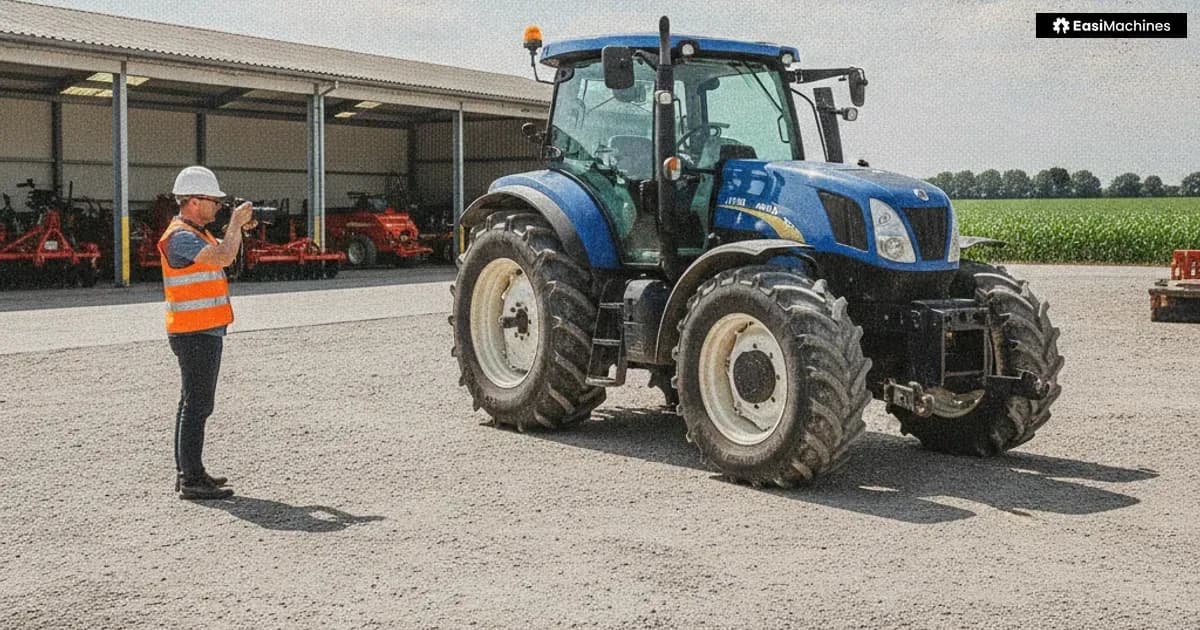
- Front three-quarter and rear three-quarter, on level ground in good light.
- Both sides, showing tyres, steps, fuel tank and any loader brackets.
- Hour meter or dash display with the ignition on, showing hours and any warning lamps.
- Chassis plate and engine number (you can blur part of the number in public photos).
- Rear linkage: lower links, top link, lift arms and quick-attach hooks.
- PTO stub and shield, engine off.
- Rear remotes and couplers, and the ISOBUS socket if fitted.
- Each tyre tread close-up front and rear.
- Front axle and hubs, showing whether they are dry.
- Cab interior: seat, controls, armrest terminal and display.
- Engine bay with side panels open, and the radiator pack.
- Any known damage or fault, photographed honestly.
- Video: a cold start, the hitch lifting and holding, remotes working and a short drive. Filming the PTO turning should be done only from a safe distance with nothing connected.
Serial and data-plate details
Buyers and their dealers use the chassis or product identification number to confirm the build specification, the year and, in some cases, recall or service campaign history. Make sure the plate is legible and matches the registration and invoice. If the engine has been replaced, say so and state the new engine’s serial number and the date.
Where and how to sell a used tractor: channels compared
General trade-offs for tractors. Fees and terms differ by auction house, dealer and marketplace.| Channel | Advantages | Trade-offs |
|---|
| Private sale | Buyers can see a cold start, hitch lift-and-hold and PTO test on your yard; you keep the sale price | You run the demonstration safely, handle the registration or RC transfer and check the payment |
| Dealer trade-in | Offset against a replacement tractor; the dealer takes on tyres, clutch or software work | The allowance reflects that reconditioning, warranty and resale margin, and is tied to the new deal |
| Live or online auction | A fixed date suits dispersals and fleets; tractors can be lotted with loaders and implements | Most bidders cannot see a cold start or hitch test; seller’s fees; collection deadlines |
| Consignment with a dealer | Viewers can see a dealer diagnostic printout on the forecourt | Commission; the tractor may sit through a season before it sells |
| Online marketplace | Reaches buyers searching by model, transmission and power across regions | Distant buyers need cold-start, hitch and PTO video; you screen enquiries |
Handling enquiries, inspections and demonstrations safely
- Answer the questions buyers commonly ask before they travel: hours, transmission, remotes, tyres, loader and why you are selling.
- Share the written fault list and service records before the visit, so the inspection confirms rather than surprises.
- Welcome an independent technician; serious buyers of larger tractors often bring one.
- Only a trained operator should run the tractor. Keep everyone clear of the PTO shaft, the hitch and any loader, and never let anyone stand between the tractor and an implement while the hitch moves.
- For inspection underneath, the engine must be off, the key removed and the hitch, loader and implements lowered or mechanically supported.
- Do not allow test drives on public roads unless the driver is licensed and insured for it.
Payment safety and the written agreement
Release the tractor, and the registration or RC documents, only after the payment has cleared into your account; a transfer screenshot or an uncleared cheque is not cleared funds.
Record the sale in writing: the tractor and serial numbers, hours at sale, what is included (loader, weights, guidance, activations), the price and payment terms, the known faults disclosed, the condition basis, and the handover date. The free equipment sale agreement generator produces a document for both parties to check and sign. For legal questions about your jurisdiction, consult a qualified adviser.
Loading, transport and export paperwork
- Registration transfer: where tractors are registered, complete and file the transfer as your local rules require; until then you may remain the recorded owner.
- Loading: agree who loads and who is liable. Use a ramp or loading dock rated for the weight, a trained driver, and the manual’s tie-down points. Remove or secure loose weights, buckets and the loader.
- Dimensions: give the transporter the width over tyres, height to the top of the cab and beacon, and weight with ballast.
- Export: a commercial invoice, packing list, bill of lading and certificate of origin are commonly needed, plus any export declaration your country requires. Some importing countries require used tractors to be cleaned free of soil and plant material and may inspect it on arrival, so check the destination’s rules before cleaning and shipping.
- Buyers abroad can check landed costs with the import cost guide.
If you are a farmer, dealer, OEM or auction house
| Seller | What matters most when selling tractors |
|---|
| Individual farmer or private seller | Registration (in India, the RC) and finance paperwork in order before listing; an honest fault list; a cold start and hitch-hold demonstration run by a trained operator; the loader and weights either included or priced separately; and cleared funds before the tractor or its documents leave |
| Contractor or fleet owner | Selling on a planned cycle before major costs fall due (tyres, transmission service, DPF cleaning); per-tractor records showing engine and PTO hours; diagnostic printouts for each unit; and timing sales outside the drilling and harvest windows when the tractors are needed |
| Equipment dealer | Consistent condition grading across trade-ins (tyre tread, clutch, hitch creep, stored codes); reconditioning listed item by item, including software updates; complete transmission, pump and remote data so the listing filters correctly; and stock turn before pre-season demand passes |
| Manufacturer or OEM | Certified-used tractors listed with the published inspection checklist and warranty scope (stating whether the CVT or powershift is covered); ex-demonstration tractors listed with hours, specification and which activations stay with the tractor |
| Auction house | Lot descriptions with chassis serial, hour-meter and tyre-tread photos, transmission, pump type, remotes and PTO speeds; the loader, weights and guidance lotted or stated clearly; and published viewing times that allow a cold start |
Common brands and model lines in this category
Listed alphabetically as examples only. Model lines and power ranges vary by country and model year.| Brand | Example model lines | Typical size/class |
|---|
| Case IH | Farmall, Maxxum, Puma, Magnum, Steiger and Quadtrac | Utility to high-horsepower and articulated 4WD |
| Claas | Arion, Axion, Xerion | Mid-range to high-horsepower |
| Deutz-Fahr | 5 Series, 6 Series, 7 Series, 8280 TTV | Utility to high-horsepower |
| Escorts Kubota | Farmtrac, Powertrac | Small to mid-range (common in India) |
| Fendt | 300, 500, 700, 900 and 1000 Vario | Mid-range to high-horsepower |
| John Deere | 5E and 5M, 6R, 7R, 8R, 9R | Utility to high-horsepower and articulated 4WD |
| Kubota | M5, M7 |
Use the exact model designation in your listing title, for example a Mahindra Arjun or Yuvo Tech+ variant, a Fendt 700 Vario generation or a Case IH Puma with its CVT or powershift transmission, because buyers search by model and transmission together.
Tractor-specific selling tips
- State the transmission in the title: it is one of the first things tractor buyers ask, and powershift or CVT is hard to add later.
- Show the tyres honestly: they are often the largest near-term cost a buyer deducts, and close-ups prevent disputes.
- Decide on the loader: sell it with the tractor or separately, and say which; include bracket and valve details.
- Keep the tractor ready for a cold start on viewing day, with a charged battery and fuel.
- Get a diagnostic printout on electronically controlled tractors before listing; a long clean history is useful evidence.
- Remove personal data from guidance displays and telematics accounts, and cancel or transfer subscriptions as agreed.
Selling a used tractor?
List your tractor with its hours, transmission and hydraulics, and deal directly with buyers.
List your tractorFrequently Asked Questions
What records do tractor buyers ask for first?
Proof of ownership and, where tractors are registered, the registration in the seller’s name; confirmation of no outstanding finance; service records with dates and hours; invoices for clutch, transmission, front axle or engine work; and, on electronically controlled tractors, a recent dealer diagnostic printout. A list of guidance and ISOBUS activations with serial numbers also helps.
Should I fix faults before selling a tractor?
Small, cheap and certain fixes, such as a leaking coupler, a broken light, a missing PTO shield or an overdue service, often remove an easy reason for a buyer to discount. Larger repairs are less certain to pay back, and some buyers prefer to choose their own repairer. Whatever you decide, disclose known faults in writing.
How should I show a tractor working to a buyer?
Start it cold in front of the buyer, then let a trained operator demonstrate the hitch lifting and holding a suitable implement, each remote, the PTO at each speed with nothing connected and everyone clear, and a drive through the gears or powershift steps. Ideally show it pulling a real implement. Keep everyone clear of the PTO, hitch and loader throughout.
Is it better to trade a tractor in or sell it privately?
A trade-in is simpler and settles against a new purchase, but the dealer must allow for reconditioning and resale margin. A private sale usually takes more time, enquiries and paperwork, and the risk of payment and ownership checks sits with you. Auctions and consignment fall between the two. The right channel depends on how much time and risk you want to take on.
Do I need to transfer guidance activations when I sell?
It depends on the manufacturer and the product. Some activations are tied to a display or receiver serial number and travel with the hardware; some subscriptions end or need the dealer to transfer them. Ask your dealer what transfers, and state in the listing and the agreement exactly what is included.
Does EasiMachines value my tractor or handle the payment?
No. EasiMachines is a marketplace where buyers and sellers deal directly. It does not inspect, value, hold money or broker sales. You set the price and agree the terms with the buyer.
About this guide
This guide is general information about this category of machine. It is not advice to buy, sell or value any particular machine, and it is not financial, tax or legal advice. Brands and models are named only as examples of what is commonly found in this category, listed in alphabetical order; naming them is not an endorsement or a criticism, and EasiMachines has no commercial arrangement with them. Prices, availability, taxes and regulations change and differ by country, so confirm them with the seller, the manufacturer or dealer, and a qualified independent professional before you commit. EasiMachines is a marketplace where buyers and sellers deal directly; it is not a party to any sale.