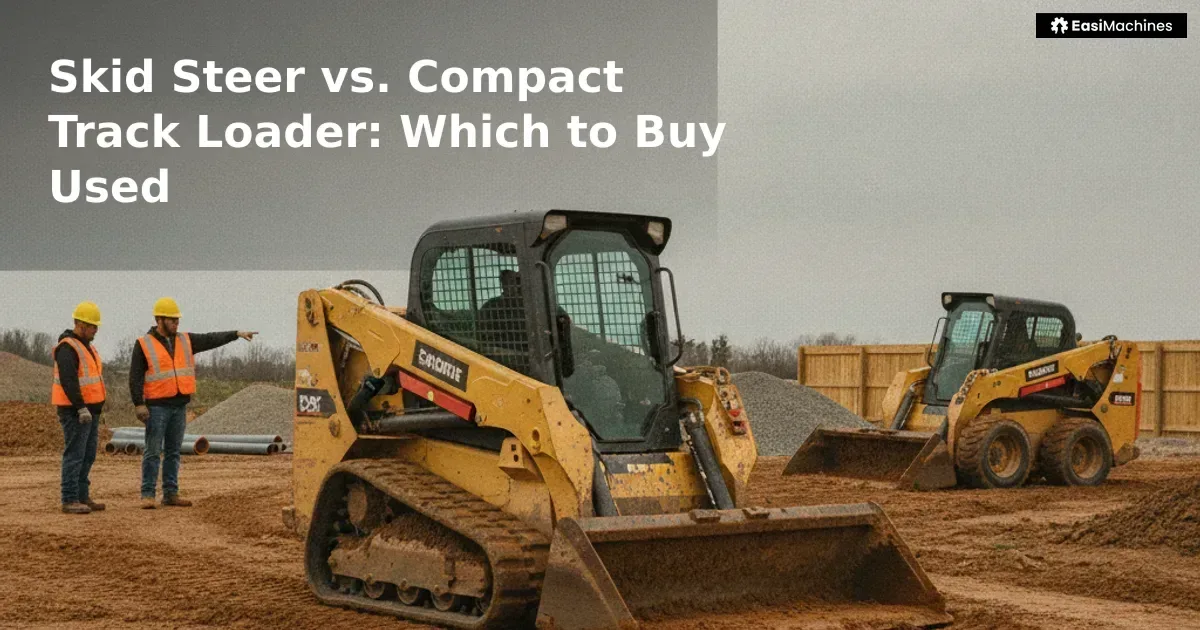
Skid Steer vs. Compact Track Loader: Which to Buy Used
Skid steers cost less to buy and maintain; compact track loaders handle soft and uneven ground better. The wrong choice costs you either in tyre bills or a machine sitting idle between jobs. Here is how to decide.
The EasiMachines Editorial Desk·EasiMachines Editorial Team·September 13, 2026 · 6 min read
Skid steers cost less to buy and maintain; compact track loaders handle soft and uneven ground better. The wrong choice costs you either in tyre bills or a machine sitting idle between jobs. Here is how to decide.
Buyers looking at a used skid steer or compact track loader (CTL) often treat the choice as a matter of brand preference or whatever is cheapest on the day. That approach works until the machine arrives on a jobsite it was never suited to — a skid steer spinning its tyres on soft clay, or a CTL with worn undercarriage eating into a budget built around tyre costs. The machine you choose changes your operating cost, your available work seasons, and what it sells for when you are done with it. The decision is worth fifteen minutes.
Ground Pressure: The Number That Defines Where Each Machine Works
Ground pressure is the machine's weight spread across the contact area of its tyres or tracks. A skid steer on rubber tyres concentrates load into four relatively small footprints. A CTL spreads its weight across the full length of both rubber tracks. In practical terms, a CTL typically exerts ground pressure in the range of 4–6 psi (pounds per square inch), while a wheeled skid steer of similar operating weight sits closer to 30–40 psi. That difference is decisive on soft, wet, or freshly graded ground — a CTL floats where a skid steer digs in and loses traction.
If your work is predominantly on compacted gravel yards, concrete slabs, paved surfaces, or dry hardpack, a skid steer loses very little to a CTL in traction terms and wins on purchase price and undercarriage simplicity. If your sites include turf, mud, sand, or slopes where surface disturbance matters (landscaping handovers, utility trenching in wet seasons, golf course work), the CTL is not a luxury — it is the machine that finishes the job without re-grading behind itself.
Maintenance Cost: Tyres vs. Undercarriage
This is the comparison that most used-equipment buyers underestimate. A skid steer's rubber tyres are its primary wear item and, on abrasive surfaces like demolition rubble, recycled concrete, or slag, they can wear through in 600–1,000 hours. A full set of skid steer tyres for a mid-frame machine commonly costs USD 1,500–3,000 depending on compound and size. A CTL's undercarriage — rubber tracks, drive sprockets, rollers, and idlers — wears more gradually on soft ground but accelerates sharply on abrasive surfaces or when operated with high side-loading. Full track replacement on a mid-frame CTL can run USD 5,000–12,000 or more, and the replacement interval is heavily condition-dependent.
When inspecting a used CTL, check track tension (the track should sag roughly 1.5–2 inches at mid-span when checked on flat ground), inspect each bottom roller for flat spots and seal leaks, and look at the sprocket teeth for hooked or shark-fin wear — that profile means the track and sprocket have been running misaligned or the track was over-tensioned. On a skid steer, check tyre sidewall cracking and tread depth, but also look at the drive chain tension and the loader arm pivot bushings, which wear faster when machines have been used heavily with the bucket curled back against the stops.
Skid steer tyres: inspect tread depth, sidewall cracks, and uneven wear (one side wearing faster indicates a bent rim or alignment issue).
CTL tracks: check for exposed cords, cracking at the track guide lugs, and missing drive lugs — any of these require imminent replacement.
CTL rollers: a roller with a flat spot causes a rhythmic vibration at operating speed and accelerates track wear; spin each one by hand if the machine is off.
Both types — hydraulic hose condition: look at hose runs near the loader arm pivot; flexing hoses here crack early and are a reliable indicator of maintenance history.
Hours vs. condition: a 2,000-hour skid steer used on a landscaping site may have less real wear than a 1,200-hour machine that spent its life on a demolition pad.
Resale Value: Which Machine Holds Better
As a category, skid steers tend to have broader used demand — more buyers can use them, and their lower entry price and simpler maintenance mean more small operators are in the market. That wider buyer pool generally supports resale liquidity: it is easier to find a buyer quickly. CTLs command a higher purchase price new and used, and they retain strong value when undercarriage condition is demonstrably good. A CTL with worn tracks and damaged rollers, however, can lose value sharply because the repair cost is visible to any informed buyer and will be discounted hard.
If you are buying used with resale in mind, a skid steer in clean mechanical condition with documented service history is generally the more predictable investment. A CTL at the right price with a recent undercarriage service or track replacement can represent strong value — the expensive work is already done — but you need to verify the work with receipts, not just the seller's word. Automated valuation tools, including EasiMachines' pricing guidance, give you a directional range based on make, model, year, and hours, but they cannot account for undercarriage condition, which is the single largest value variable in a used CTL.
Making the Decision: A Practical Path
Answer three questions before you commit to either machine. First: what surface do you spend more than 60% of your working hours on? If it is hard and abrasive, choose the skid steer. If it is soft, wet, or sloped, choose the CTL. If it is genuinely mixed, factor in tyre replacement cost against track replacement cost at your expected annual hours. Second: what is your total budget including likely first-year repair? A used CTL priced attractively may be priced that way because the tracks are due. Get a pre-purchase inspection from an independent mechanic, not the seller's dealer. Third: do you need to move the machine frequently between sites on a trailer? Skid steers are narrower and lighter than equivalent-capacity CTLs, which matters if your trailer is at its rated limit.
One check that pays for itself: ask the seller for the hour meter reading and cross-reference it against the condition of the seat foam, the pedal rubber, and the wear on the loader arm contact points. Hour meters can be replaced; seat foam and pedal rubber cannot lie. If the hours look low and the cab looks like it has been through a decade, investigate further before price discussions go any further.
Where EasiMachines Helps — and Where It Does Not
EasiMachines lists both skid steers and CTLs from dealers and private sellers, and the platform's pricing tool gives you a market-range estimate based on make, model, year, and hours. That estimate helps you enter a negotiation knowing whether an asking price is at the top, middle, or bottom of what similar machines are listed at. It does not replace a physical undercarriage inspection, and it does not verify the mechanical claims in a listing — no automated tool can do that for a used machine.
There is currently no EasiMachines-specific inspection verification programme or certified used designation for skid steers and CTLs. If that changes, it will be documented on the platform. For now, use the marketplace to identify candidates and benchmark asking prices, then apply the physical inspection checks in this guide before committing.
About the author
The EasiMachines Editorial Desk
EasiMachines Editorial Team
Written and reviewed by the EasiMachines editorial team.