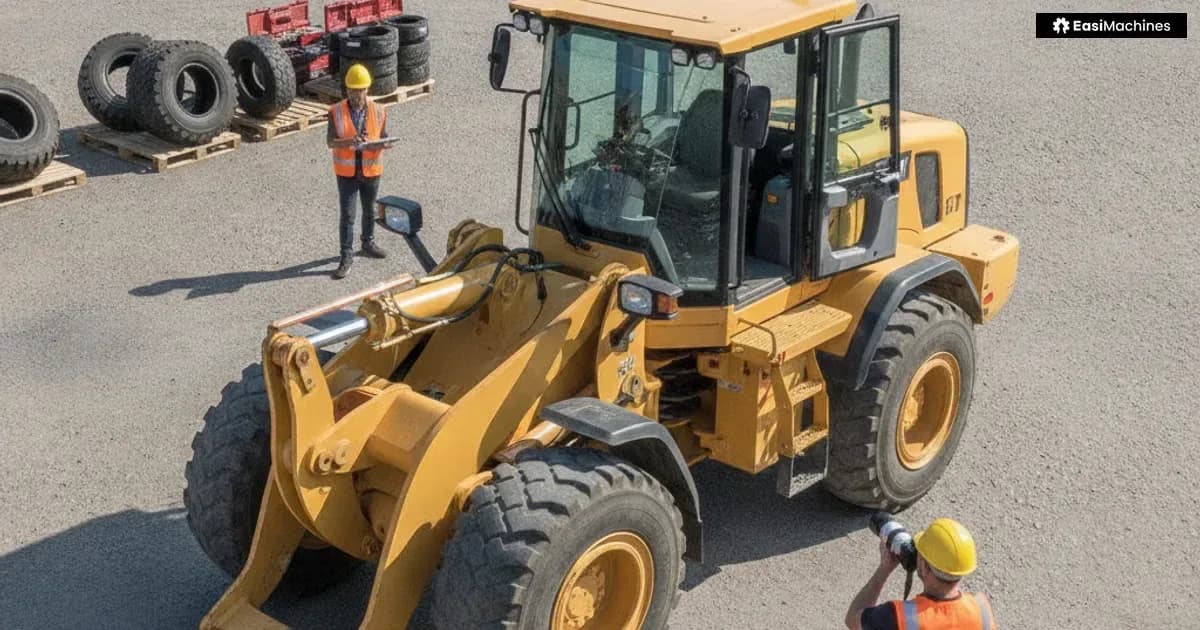
Preparing to sell a used wheel loader: records, cleaning and the demo
The documents wheel loader buyers ask for
- Ownership. Proof that you own the machine and that any finance has been settled.
- Service history. Dates, hours and work done, with oil changes on the engine, transmission, axles and hydraulics, and any oil sample results.
- Major repairs. Invoices for transmission or torque converter, axles and brakes, hinge pins and bearings, lift arm pins and engine work.
- Readings, if taken. A stall test against the manufacturer’s figure, transmission clutch pressures, and axle oil samples, where rising wear metals can show wet brake wear.
- Application history. What material, what work, how many shifts.
- Tyres. When fitted, the size and type, and any repairs.
- Scale. Make, type, calibration records and any trade approval.
- Telematics. A fault-code or utilisation history where the machine has one.
- Attachments. Buckets with capacities, coupler type, forks or grabs, with serial numbers.
- Road status. Registration documents if the machine is road-registered.
Cleaning
Clean the hinge area, the axles, the lift arms and the radiator so they can be seen. Machines from waste, scrap or timber work often carry debris around the radiator and underside, and buyers look there. Clean a few days before viewings so any leak shows honestly, and clean the cab and glass.
Fix small faults or disclose them
Cheap items such as lights, wipers, mirrors, a missing grease nipple or a worn seat cover are often worth fixing, and every pin should be greased before viewings. Larger items, such as hinge play, a slipping clutch pack, an axle leak, brake wear or a cracked bucket, are usually better disclosed with a photo. Undisclosed faults that a buyer finds undermine trust in the rest of the listing.
Showing it running
- A cold start, with the exhaust visible.
- Lift and tilt through full movements, with the arms held raised to show they do not drift.
- The coupler locking and releasing, and each attachment.
- Steering lock to lock and sharp corrections, while someone watches and listens at the hinge for a clunk.
- Travel through all gears in both directions, then forward-reverse shuttles under load, the differential locks and ride control where fitted, and the brakes. Expect a buyer to feel each hub afterwards for heat from a dragging brake.
- A loading cycle into a truck or pile if the site allows, and the scale reading if fitted.
Pricing a used wheel loader
The price drivers
- Model, generation, hours and application.
- Tyres: size, type and tread remaining on all four.
- Linkage, bucket and coupler, and the attachments included.
- Drive type and options: transmission type, ride control, differential locks, scale, application packages.
- Emission stage, which affects which buyers and countries can use the machine.
- Records and documents.
Comparables
Find loaders of the same model and generation with a similar hours band and the same linkage and bucket. Separate asking prices on listings from sold prices in published auction results, and adjust for tyres, attachments, records and location. Decide your asking price and lowest acceptable figure before enquiries arrive. The free equipment appraisal calculator and pricing guide are a starting point, not a valuation of your machine. For how records and condition affect a loader’s resale value, see our resale value guide.
Writing the listing
Specs to state
- Make, model and full designation including suffix (for example Caterpillar 966 GC, Komatsu WA380-8, Volvo L120H, John Deere 544 P-Tier or Case 721G), year, hours, and whether the hour meter has been replaced.
- Serial number or PIN and where the data plate is.
- Operating weight as configured, linkage type (Z-bar, parallel-lift or high-lift) and drive type.
- Bucket type and capacity, coupler type, and every attachment included.
- Tyre size, tread class (for example L-3, L-4 or L-5), radial or bias, make, foam fill if any, and approximate tread remaining on each.
- Options: ride control, differential locks, scale (production or trade-approved), cameras, application packages, fire suppression.
- Cab type, air conditioning, emission stage, road registration if any.
- Location, availability for inspection, and what is included in the price.
Photos to include
- Front three-quarter view from each side, and rear three-quarter view from each side.
- Each tyre showing the tread, and the sidewalls.
- The articulation hinge, top and bottom, the steering cylinders and the steering stops.
- The lift arms, linkage pins and tilt cylinder.
- The bucket: cutting edge, teeth or bolt-on edge, wear plates and corners.
- The coupler, and all attachments laid out together.
- The axles, driveshafts, the rear axle oscillation trunnion and the area under the transmission.
- The engine bay, radiator and cooling package.
- The cab, controls, monitor and hour meter with the ignition on.
- The data plate or PIN, readable.
- Any fault you are disclosing.
Videos to include
A cold start filmed from outside, lift and tilt, steering lock to lock, travel through the gears in both directions, and a loading cycle. Keep the sound on, because buyers listen to the transmission, axles and hinge.
Sale channels and their trade-offs
Trade-offs between sale channels. Fees and terms vary by country and company; confirm them before you commit.| Channel | Strengths | Trade-offs |
|---|
| Private sale through a marketplace | You present the application history, tyre photos and a loading video to the operator who will use the loader | You handle calls, viewings and inspector visits |
| Dealer trade-in | One transaction when replacing it | The dealer prices in tyres, hinge and brake work, so the figure is usually lower |
| Auction | A fixed date and a wide contractor, quarry and export audience | Sold as seen; buyers bid on catalogue tyre and hours data; haulage to the site |
| Consignment with a dealer | The dealer shows the loader and handles enquiries | Commission or fees; time on the yard |
If you are a private seller, fleet owner, dealer, manufacturer or auction house
Who is selling changes what buyers expect to see. The points below are where each type of seller usually needs to be strongest.
Each route plays a different role; none is right for every machine or every seller.| Audience | What matters most |
|---|
| Private owner selling one machine | Complete records, honest tyre and hinge disclosure with photos, a clear attachments list, time set aside for viewings, and payment safety. |
| Quarry, waste or fleet owner | Selling individually or as a batch, consistent condition and tyre data across units, cleaning after waste or scrap work, and timing against replacements. |
| Equipment dealer | Reconditioning to a stated standard, tyres fitted or stated, any warranty offered, consistent listing data, and stock turn. |
| Manufacturer or OEM certified-used | Publishing certification checklist results, any factory cover that transfers, and the inspection date and hours. |
| Auction house | Catalogue data with suffix, linkage, bucket, coupler and tyre condition; lotting with attachments; condition reports covering hinge and axles; inspection days. |
Handling enquiries, inspections and demonstrations safely
Ask enquirers what material and trucks the loader will work with. That tells you whether the bucket, linkage and tyres suit them and saves wasted visits. Send the records, tyre details and extra photos before a viewing.
Expect a serious buyer to bring an inspector, who may want to check the hinge, read transmission pressures or take oil samples. Agree this in advance. At the demonstration:
- Only a competent, insured operator runs the machine.
- Keep everyone well clear of the machine’s path, including behind it, and away from the articulation area, which closes when the machine steers.
- Fit the articulation lock and lower the bucket before anyone goes near the hinge or between the frames.
- Nobody stands under raised lift arms. Use the lift arm support and lock out the machine for any close check.
- Lower the bucket to the ground, apply the parking brake and stop the engine before anyone approaches.
Payment safety and the written agreement
Release the loader, its keys, scale settings and any telematics account only after the full payment has cleared, confirmed with your own bank. Record the PIN, hours, linkage, bucket, coupler and tyres included in a written sale agreement.
Loading, transport and export paperwork
Wheel loaders usually travel on low-loaders. Width over the tyres and height over the cab can exceed limits for larger machines, and the bucket may travel separately. Fit the articulation lock before loading, and secure the machine using the tie-down points in the operator’s manual. Agree in writing who arranges and pays for transport and when risk passes to the buyer.
For export, expect a commercial invoice, packing list, bill of lading, export declaration and certificate of origin. Many destinations require machines to be washed free of soil and plant material, and some restrict the age or emission stage of imports. Buyers abroad can estimate landed cost with the import cost calculator. A freight forwarder or customs broker can confirm the paperwork.
Common brands and model lines in this category
Neutral examples in alphabetical order, not a ranking. State the exact model, suffix and serial in your listing.| Brand | Example model lines | Typical size/class |
|---|
| Case | 621G, 721G | Mid-size |
| Caterpillar | 950 GC, 966 GC, 980 GC; current medium range from 950 to 982 | Medium |
| Develon (formerly Doosan) | DL250-7 | Mid-size |
| Hitachi | ZW180-7, ZW220-7 | Mid-size |
| JCB | 435S, 437, 457 | Mid-size |
| John Deere | 544 P-Tier, 624 P-Tier, 644 P-Tier | Mid-size |
| Komatsu | WA380-8 | Mid-size |
|
Tips specific to selling a wheel loader
- State the application. Say what material the machine handled and for how long.
- Photograph every tyre. Tyre condition is often one of the first things buyers price.
- State the drive type and linkage. Buyers matching a machine to their work search on these.
- Keep the bucket and coupler with the machine unless you state otherwise.
- Clean the radiator and underside after waste, scrap or timber work.
- Be clear about the scale. Say whether it is a production scale or trade-approved, and when it was last verified.
How EasiMachines helps
EasiMachines is a marketplace where buyers and sellers deal directly. You can list a wheel loader with its records, tyre details, photos and videos, and buyers contact you. EasiMachines does not inspect, value, hold money or broker deals, and it takes no sales commission.
List your wheel loader
Create a listing with the spec, tyre details, records and photos loader buyers look for.
List a wheel loaderFrequently Asked Questions
What do buyers of a used wheel loader ask first?
Usually the hours and what material the machine handled, the condition of the tyres, the articulation hinge, the transmission and axles, and what bucket and coupler come with it. Stating the application and the tyre condition in the listing answers many early questions.
Should I fit new tyres before selling a wheel loader?
Not necessarily. New tyres are a large cost, and buyers may want a different tread type for their work. Stating the tyre size, type and tread remaining, with photos of each tyre, lets buyers price them in. Compare the cost of tyres with the comparables before deciding.
What should a wheel loader demonstration include?
A cold start, lift and tilt through full movements with the arms held raised, the coupler and each attachment, steering lock to lock, travel through all gears in both directions, the brakes, and a loading cycle into a truck or pile if the site allows. A competent operator runs it while everyone else stays well clear.
How do I describe a payload scale in a listing?
State the scale make and type, whether it is a production scale or approved for trade use, and the date of the last calibration or verification. Buyers who sell material by weight will check whether the approval can continue with them.
What paperwork is needed to export a used wheel loader?
Typically a commercial invoice, packing list, bill of lading, export declaration and certificate of origin. Many destinations require machines to be washed free of soil, and some restrict the age or emission stage of imports. Confirm the details with a freight forwarder or customs broker.
Does EasiMachines take commission or handle payment?
No. EasiMachines is a marketplace where buyers and sellers deal directly. It does not inspect, value, hold money or broker deals, and it takes no sales commission. You can record the terms in a free sale agreement.
About this guide
This guide is general information about this category of machine. It is not advice to buy, sell or value any particular machine, and it is not financial, tax or legal advice. Brands and models are named only as examples of what is commonly found in this category, listed in alphabetical order; naming them is not an endorsement or a criticism, and EasiMachines has no commercial arrangement with them. Prices, availability, taxes and regulations change and differ by country, so confirm them with the seller, the manufacturer or dealer, and a qualified independent professional before you commit. EasiMachines is a marketplace where buyers and sellers deal directly; it is not a party to any sale.