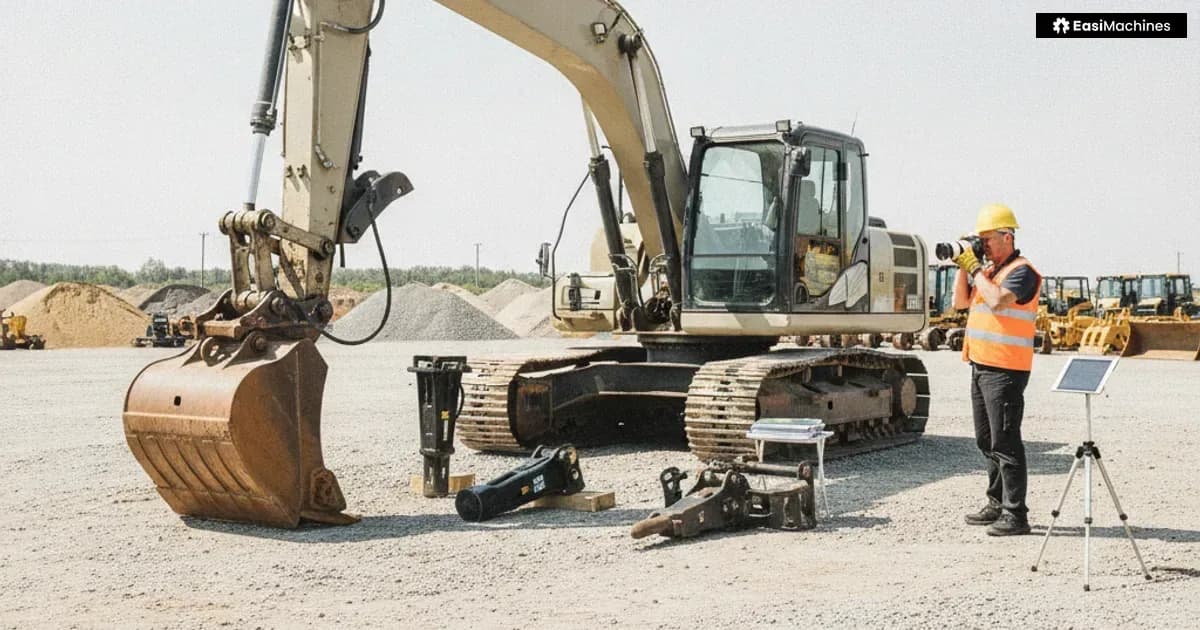
Preparing to sell a used crawler excavator: records, cleaning and the demo
The documents excavator buyers ask for
- Ownership. Proof that you own the machine and that any finance has been settled. In the UK, note any CESAR registration.
- Service history. Dates, hours and work done, with oil and filter changes on the engine, hydraulics, slew and final drives.
- Undercarriage report. A dated measurement of links, bushings, rollers, idlers and sprockets, if you have one.
- Major repairs. Invoices for undercarriage, slew bearing or gear, travel motors, final drives, main pump, engine, and re-pinning or line boring.
- Lifting. Thorough examination reports if the machine has been used for lifting (LOLER in the UK), and whether hose-burst valves and an overload warning are fitted.
- Readings, if taken. Main and relief pressures, case-drain flow on the pump and travel motors, swing-bearing play against the manufacturer’s limit, and oil sample results. Dated readings answer the questions an inspector would otherwise need a day to settle.
- Telematics. A fault-code or utilisation history where the machine has one, and the engine hours held in the control module if a dealer has read them.
- Attachments. A list of buckets with widths, the coupler type, hammer, tilt rotator, grab or shears, with serial numbers.
- Manuals and keys. Operator and parts manuals and the number of keys.
Cleaning
Clear packed material from the track frames, rollers and sprockets so the undercarriage can be seen and measured. Clean the boom foot, arm and bucket linkage, the slew area and the pump compartment. Do this a few days before viewings so any leak shows honestly; a freshly steam-cleaned pump bay on viewing day makes some buyers suspicious. Clean the cab and glass.
Fix small faults or disclose them
Cheap items such as lights, wipers, a cracked mirror, a missing grease nipple or a torn seat cover are often worth fixing, and every pin should be greased before viewings. Larger issues, such as pin slop, a weeping cylinder, a slew that clunks on reversal or a travel motor leak, are usually better disclosed with a photo. A buyer who finds something you did not mention starts to doubt the rest.
Showing it running
- A cold start, with the exhaust visible. Then let the hydraulic oil reach working temperature: buyers time cycles and check drift with hot oil, because internal wear shows as the oil thins.
- Boom, arm and bucket through full movements, then combined movements, with the front end held raised to show it does not drift.
- Slew both ways, with a stop and reversal.
- Travel in both speeds and directions, steering both ways.
- Each auxiliary circuit with its attachment, and the coupler locking and releasing with its indication.
- A short dig or loading cycle if the site allows.
Pricing a used excavator
The price drivers
- Model, generation, hours and application, including how much hammer or demolition work.
- Undercarriage condition, with measurements where you have them.
- Front end and carriage: mono, adjustable or long-reach boom; arm length; standard or long carriage; shoe width.
- Hydraulics and attachments: auxiliary circuits, coupler, hammer, tilt rotator and bucket set.
- Emission stage, which affects which buyers and countries can use the machine.
- Records and documents, including lifting certificates.
Comparables
Find excavators of the same model and generation, a similar hours band and the same main spec. Separate asking prices on listings from sold prices in published auction results, and adjust for attachments, undercarriage condition and location. Decide your asking price and lowest acceptable figure before enquiries arrive. The free equipment appraisal calculator and pricing guide are a starting point, not a valuation of your machine. For how hours affect buyers’ views, see how many hours is too many for an excavator.
Writing the listing
Specs to state
- Make, model and full designation including suffix (for example Caterpillar 320, Komatsu PC210LC-11, Hitachi ZX210LC-7, Volvo EC220E or Kobelco SK210LC-10), year, hours, and whether the hour meter or display has been replaced.
- Serial number or PIN and where the data plate is.
- Operating weight as configured, boom and arm type and length, carriage (standard or LC) and shoe width.
- Auxiliary circuits (one-way, two-way, extra circuits for a tilt rotator), proportional controls and flow settings.
- Coupler type and the attachments included, with widths and serials.
- Lifting equipment: hose-burst valves, overload warning and the latest thorough examination date.
- Undercarriage condition with date and who measured it, cab type, air conditioning, cameras and machine control.
- Emission stage, location, availability for inspection, and what is included in the price.
Photos to include
- Front three-quarter view from each side, and rear three-quarter view from each side showing the counterweight.
- Each track side on, showing links, shoes, rollers, idlers and sprocket.
- Close-ups of the sprocket teeth, front idler and carrier rollers.
- Travel motor and final drive housings on both sides.
- Boom foot, boom-to-arm pin, arm nose and bucket linkage pins.
- Boom, arm and bucket cylinder rods.
- The slew ring area and the pump compartment.
- The engine bay, radiator and hydraulic tank.
- The cab, controls, monitor and hour meter with the ignition on.
- The data plate or PIN, readable.
- The coupler, and all attachments laid out together.
- Any fault you are disclosing.
Videos to include
A cold start filmed from outside, full and combined movements, slew with a reversal, travel in both directions, and each attachment working. Keep the sound on, because buyers listen to the pump, slew and travel motors.
Sale channels and their trade-offs
Trade-offs between sale channels. Fees and terms vary by country and company; confirm them before you commit.| Channel | Strengths | Trade-offs |
|---|
| Private sale through a marketplace | You present the attachments, circuits and undercarriage readings to the operator who will run the excavator | You handle calls, viewings and inspector visits with pressure gauges |
| Dealer trade-in | One transaction when replacing it; the dealer can take the attachments too | The dealer prices in pins, undercarriage and preparation, and may value attachments low |
| Auction | A fixed date and a wide contractor and export audience | Sold as seen; attachments may be lotted separately; haulage to the site |
| Consignment with a dealer | The dealer shows the machine and its attachments | Commission or fees; time on the yard |
If you are a private seller, fleet owner, dealer, manufacturer or auction house
Who is selling changes what buyers expect to see. The points below are where each type of seller usually needs to be strongest.
Each route plays a different role; none is right for every machine or every seller.| Audience | What matters most |
|---|
| Private owner selling one machine | Complete records, a clear attachments list, honest disclosure with photos, time set aside for viewings, and payment safety. |
| Contractor or fleet owner | Selling individually or as a batch, consistent condition and undercarriage data across units, and timing against replacement deliveries. |
| Equipment dealer | Reconditioning to a stated standard, any warranty offered, consistent listing data across stock, and stock turn. |
| Manufacturer or OEM certified-used | Publishing certification checklist results, any factory cover that transfers, and the inspection date and hours. |
| Auction house | Catalogue data with model suffix, boom, carriage and circuits; lotting with coupler and attachments; condition reports with undercarriage readings; inspection days. |
Handling enquiries, inspections and demonstrations safely
Ask enquirers what the machine is for and which attachments they run. That tells you whether the hydraulics and coupler suit them and saves wasted visits. Send the records, attachments list and extra photos before a viewing.
Expect a serious buyer to bring an inspector, who may want to measure the undercarriage, read pump pressures or take oil samples. Agree this in advance. At the demonstration:
- Only a competent, insured operator runs the machine.
- Keep everyone well outside the slew radius, including the counterweight swing behind the machine.
- Nobody approaches while the engine is running or the front end is raised.
- Lower the bucket or attachment to the ground, engage the hydraulic lockout and stop the engine before anyone looks closely.
- Lock out the machine for any check near the tracks, slew or linkage.
Payment safety and the written agreement
Release the excavator, its keys, attachments and any telematics or machine-control account only after the full payment has cleared, confirmed with your own bank. Record the PIN, hours, boom and carriage spec, the coupler and every attachment included in a written sale agreement.
Loading, transport and export paperwork
Crawler excavators travel on low-loaders. The transport height with the boom folded is often the limiting dimension, and larger machines may need permits or travel with the counterweight or front end removed. Agree in writing who arranges and pays for transport, who handles any dismantling, and when risk passes to the buyer. Load with a competent operator, using the tie-down points in the operator’s manual and the haulier’s instructions.
For export, expect a commercial invoice, packing list, bill of lading, export declaration and certificate of origin. Many destinations require machines to be washed free of soil, and some restrict the age or emission stage of imports. Buyers abroad can estimate landed cost with the import cost calculator. A freight forwarder or customs broker can confirm the paperwork.
Common brands and model lines in this category
Neutral examples in alphabetical order, not a ranking. State the exact model, suffix and serial in your listing.| Brand | Example model lines | Typical size/class |
|---|
| Caterpillar | 320, 336 and 336 GC | Around 20 tonnes and around 36 tonnes |
| Develon (formerly Doosan) | DX225LC-7, DX300LC-7M | Around 22 tonnes and around 32 tonnes |
| HD Hyundai | HX220A L, HX300A L | Around 22 tonnes and around 33 tonnes |
| Hitachi | ZX210LC-7, ZX350LC-7 | Around 23 tonnes and around 35 to 37 tonnes |
| JCB | JS220 | Around 22 tonnes |
| Kobelco | SK210LC-10, SK350LC-10 | Around 21 tonnes and around 38 tonnes |
| Komatsu | PC210LC-11, PC360LC-11 |
Tips specific to selling a crawler excavator
- State the suffix and generation. Buyers search by exact model, and LC, NLC or generation codes change the specification.
- Explain the hours. Say how much was hammer, demolition or lifting work.
- Be precise about attachments. List what is included, and show it in the photos.
- Show both tracks. Photos of only one side make buyers wonder about the other.
- Grease the pins before viewings, and disclose known play. Dry pins sound worse than they are, but grease does not hide play an inspector will measure at the boom foot, arm nose and bucket linkage.
- Clean thoroughly if the machine may be exported. Soil in the track frames can delay shipping.
How EasiMachines helps
EasiMachines is a marketplace where buyers and sellers deal directly. You can list an excavator with its records, attachments, photos and videos, and buyers contact you. EasiMachines does not inspect, value, hold money or broker deals, and it takes no sales commission.
List your crawler excavator
Create a listing with the spec, attachments, records and photos excavator buyers look for.
List a crawler excavatorFrequently Asked Questions
What do buyers of a used excavator ask for first?
Usually the hours and what the machine did, the undercarriage condition, the attachments and hydraulic circuits included, and the service records. A recent undercarriage measurement and a clear list of buckets, coupler and hammer answer most early questions before anyone travels.
Should I sell the excavator with its attachments or separately?
Either can work. Many buyers search for machines that are already set up, and a coupler, bucket set or tilt rotator matched to the hydraulics can make the machine easier to sell. Selling attachments separately can suit a buyer who already has their own. State clearly what is included in the price.
How do I show a used excavator working without risk?
A competent, insured operator runs it while everyone else stays well outside the slew radius. Show a cold start, boom, arm, bucket and slew through full and combined movements, travel in both directions, each auxiliary circuit with its attachment, and the coupler locking. Lower the front end and stop the engine before anyone approaches.
Do I need lifting certificates to sell an excavator?
Not to sell it, but if it was used for lifting, buyers will ask for thorough examination reports (LOLER in the UK) and whether hose-burst valves and an overload warning are fitted. Stating this clearly helps buyers who plan to lift with it.
How do I prove the hours on a used excavator?
Service records with dates and hours, invoices for major work, and a telematics or fault-code history where the machine has one. Say whether the hour meter or display has ever been replaced. Consistent records across years support the reading on the meter.
Does EasiMachines take commission or handle payment?
No. EasiMachines is a marketplace where buyers and sellers deal directly. It does not inspect, value, hold money or broker deals, and it takes no sales commission. You can record the terms in a free sale agreement.
About this guide
This guide is general information about this category of machine. It is not advice to buy, sell or value any particular machine, and it is not financial, tax or legal advice. Brands and models are named only as examples of what is commonly found in this category, listed in alphabetical order; naming them is not an endorsement or a criticism, and EasiMachines has no commercial arrangement with them. Prices, availability, taxes and regulations change and differ by country, so confirm them with the seller, the manufacturer or dealer, and a qualified independent professional before you commit. EasiMachines is a marketplace where buyers and sellers deal directly; it is not a party to any sale.