What matters most, by type of seller
The same lathe can be sold by a private owner, a production plant, a dealer, a builder or an auction house. Each has different strengths and a different job to do in the sale.
A guide to priorities, not a ranking of channels. Each route suits different buyers and sellers.| If you are… | What matters most |
|---|
| An individual or small shop selling one lathe | Evidence that answers a buyer’s risk questions: hours and options screens, a test cut, honest disclosure, safe payment and a clear removal plan. First-time sellers most often underestimate removal, rigging and paperwork. |
| A production plant releasing surplus or replaced machines | Timing against the replacement machine, keeping the old lathe under power for demonstrations, releasing tooling consistently, and a removal window that does not disrupt production. |
| An equipment dealer selling stock | Accurate specifications from the data plate and control, reconditioning disclosed clearly, warranty terms in writing if offered, and photos and videos that answer remote buyers’ questions. |
| A manufacturer (OEM) or its distributor | Demonstration, ex-showroom and trade-in machines described with their history, and the scope of any refurbishment or certified-used warranty stated precisely. |
| An auction house | Catalogue data taken from the machine itself (model, serial, control, hours, options), condition notes, sensible lotting of tooling and bar feeders, viewing under power where possible, and removal terms. |
Preparation: what used CNC lathe buyers ask for
Records and documents
- Control screens: power-on time, spindle or cutting time, and the alarm history. Export the alarm history if the control allows it.
- Backups: a current parameter, PLC and macro backup on separate media. It protects you and the buyer if a battery fails during removal.
- Battery dates: when the encoder and memory batteries were last changed.
- Service history: spindle, turret or ballscrew work, hydraulic oil and filter changes, ballbar or laser calibration reports, and any crash repair with its invoice.
- Manuals and drawings: operation, maintenance, electrical and parameter manuals, plus the chuck and bar feeder manuals.
- Original acceptance sheet: if it survives, it gives the buyer a reference for runout and geometry.
- Ownership: purchase invoice or proof of title, and confirmation that any finance has been settled.
Cleaning
Clean the work envelope, turret, chuck and way covers, empty the chip conveyor and refresh or clean the coolant. Clean the cabinet exterior and the control panel. Do not repaint the turret or carriage: fresh paint in those places is read as hiding crash damage.
Fix small faults, disclose larger ones
- Fix the cheap items: work lights, door seals, a torn wiper, a weeping coolant fitting, a stuck door switch.
- Disclose the larger ones with what you know: spindle noise at a speed band, a turret index alarm, chuck pressure drift, a driven tool that runs hot.
- If you have a repair quotation, include it. A known cost is easier to negotiate than an unknown one.
- Do not reset alarm history or raise backlash compensation to hide a fault. It will be found, and it destroys trust.
Demonstrating it running and cutting
Keep the machine connected if you can. Prepare a short test programme that faces, turns two collars at the same diameter, threads, and uses the live tools and sub-spindle if fitted. Have bar or billets of a common material ready. A buyer who sees the machine warm up, index every station and cut a part that measures well is buying evidence, not a promise.
Pricing a used CNC lathe to sell
Buyers will price your lathe against comparables, so do the same first.
- Size class: swing, turning length, bar capacity and chuck size.
- Capability: live tooling, C-axis, Y-axis, sub-spindle, twin turrets and tailstock type.
- Control: model and generation, and whether it is still supported by the builder.
- Hours and history: spindle hours against power-on hours, rebuilds and crash history.
- Evidence: under power with a test cut, versus disconnected or in storage.
- Included items: holders, driven tools, chucks, jaws, collets, bar feeder, part catcher and steady rest.
- Location and removal: how easy it is to reach, lift and load, and who pays for it.
Find machines of the same builder and model family with a similar year and control. Compare within one configuration (two-axis, live tooling, Y-axis, sub-spindle) and one control generation, weight sold prices such as published auction results above asking prices that have not moved in months, then adjust for spindle hours, turret and spindle history and the tooling you include. The free equipment appraisal calculator and pricing guide give a directional starting point; neither is a certified valuation. Decide your lowest acceptable figure before enquiries start.
Writing the listing
Specifications to state
- Builder, model, year, serial number and control model.
- Swing over bed and over carriage, maximum turning diameter and length.
- Bar capacity, spindle nose (for example A2-6), chuck size and make, maximum spindle speed and motor power.
- Turret stations, tool holder system (BMT, VDI or builder-specific) and number of driven stations.
- Live-tool speed, C-axis, Y-axis travel, sub-spindle chuck size and bore, tailstock type.
- Power-on and spindle hours, and the date it last ran in production.
- Bar feeder make and model, part catcher, chip conveyor, high-pressure coolant, probe or tool setter.
- Itemised tooling, and anything that is not included.
- Location, machine weight and footprint, and whether you will load it.
Photos and videos to include
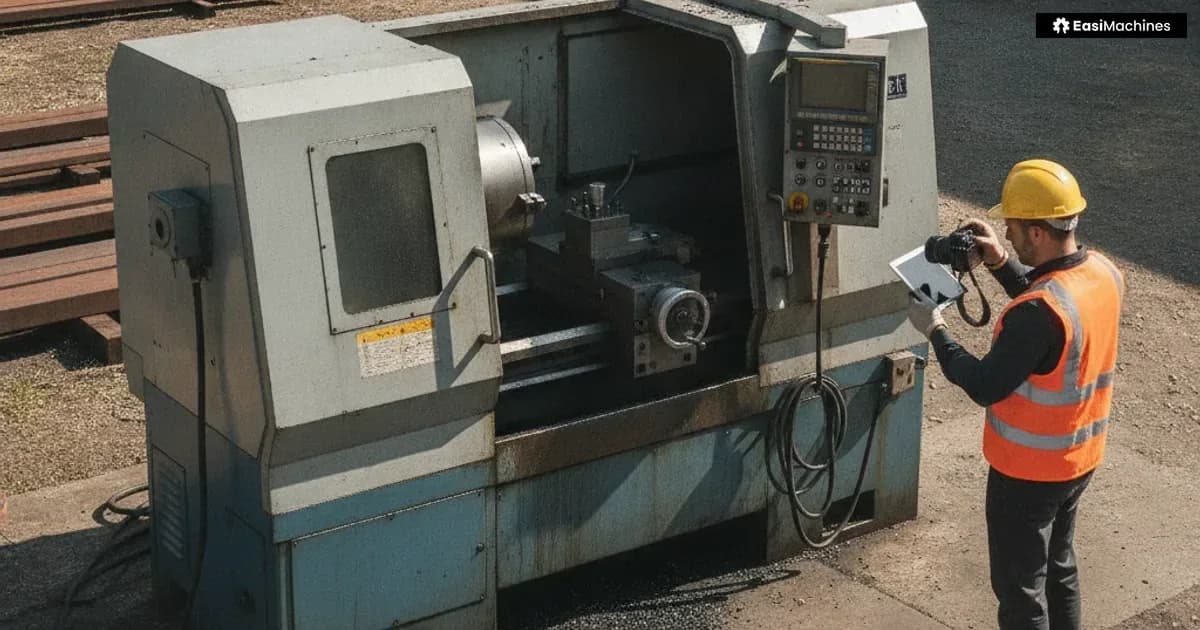
- Front three-quarter view of the whole machine, doors closed.
- The data plate showing builder, model and serial.
- The control screen showing power-on and spindle hours.
- The options or configuration screen, and the alarm history screen.
- The work envelope with doors open: chuck, turret and tailstock or sub-spindle.
- Close-ups of the turret disc and stations, and the chuck face and jaws.
- Way covers and the bed area visible from the door.
- The rear of the spindle and rotating cylinder, and the hydraulic unit with its gauge.
- The electrical cabinet with the door open (powered down).
- The tooling laid out and photographed as a set; the bar feeder if included.
- A video of a warm spindle at several speeds, a full turret index cycle, and a short cut.
- The finished test part on a measuring bench.
Photograph defects honestly. A clear photo of a dented way cover lets the buyer price it now instead of at the viewing.
Sales channels and their trade-offs
Fees and terms vary by provider; read each agreement before signing.| Channel | Advantages | Trade-offs |
|---|
| Private sale to a production shop | A buyer who needs your exact swing, bar capacity and turret system may value the tooling with it | You host test cuts, manage the bar feeder disconnection and check payment |
| Trade-in against a new lathe | One transaction timed with the replacement’s installation; the old lathe can run until the new one is accepted | The figure reflects the dealer’s resale risk on your configuration and control |
| Outright sale to a used machine tool dealer | Fast, often with rigging and turret brackets handled | Price reflects reconditioning of spindle, turret or chuck cylinder the dealer expects |
| Auction | Defined date; suits a plant releasing several lathes and tooling | Buyers price sold-as-seen spindle and turret risk; decide how holders and bar feeders are lotted |
| Consignment with a dealer or broker | Their list of turning-centre buyers; you keep title until sale | Commission, an agreed minimum, and keeping the lathe under power while it waits |
|
Enquiries, inspections and safety at demonstrations
- Ask what the buyer makes, in what material and from what bar size. It tells you whether to demonstrate the sub-spindle transfer, the Y-axis, the driven tools or the bar feeder, and whether their BMT or VDI holders will fit.
- Before a visit, agree what will be demonstrated and who will operate the machine. Only your trained operator should run it.
- Keep doors and interlocks working and closed during running. Nobody reaches into the envelope unless the machine is in emergency stop and locked out.
- Supervise visitors near the chuck, turret, bar feeder and conveyor. A hydraulic chuck or turret can move without warning.
- Let a buyer’s inspector take readings with the machine locked out, and record what was checked.
- Keep a written note of what was shown and said; it supports the sale agreement later.
Payment safety and the written agreement
Release the lathe, its tooling and the parameter backups only against cleared funds confirmed by your bank.
The written agreement for a lathe should name the serial number and control, list the enabled options as shown on screen, itemise holders, driven tools, chucks, jaws and the bar feeder, record the test-cut results and disclosed faults, and state who fits transport brackets, drains the hydraulics and loads it, by when. The free sale agreement generator records these points; it is a template, not legal advice.
Loading, transport and export paperwork
- Use the builder’s lifting instructions and transport brackets to lock the turret, carriage and tailstock or sub-spindle.
- Drain coolant and hydraulic oil as the manual requires; dispose of waste coolant through a licensed route.
- Label and disconnect the bar feeder, conveyor and any automation separately, with cables marked.
- Agree in writing who supplies the rigger, the crane or forklift and the truck, and who carries the risk during loading.
- For export: commercial invoice, packing list with weights and dimensions, proof of ownership, and the export declaration. High-accuracy turning machines can be dual-use items: the EU list, for example, includes turning machines by positioning accuracy (entries 2B001 and 2B201), while standard general-purpose lathes are generally outside control. Check the exact model with your national export authority. Buyers abroad may use our import cost calculator to estimate landed cost.
Common brands and model lines in this category
Neutral examples, alphabetical. Use the exact builder and model name in your listing, as buyers search by them.
Examples only, not an endorsement. State the exact model and options from the data plate and control.| Brand | Example model lines | Typical size/class |
|---|
| Ace Designers (Ace Micromatic Group) | Jobber series | Compact to mid-size two-axis turning |
| Citizen | Cincom L20 | Sliding-headstock (Swiss-type), small diameter bar work |
| DMG MORI | NLX, CLX | Compact to large turning centres, with mill-turn variants |
| DN Solutions (formerly Doosan) | PUMA, LYNX | Compact (LYNX) to large and multi-turret (PUMA) |
| Haas | ST series (for example ST-10, ST-20, ST-30) | Small to mid-size, with long-bed and Y-axis versions |
| Hyundai WIA | L series (for example L300, L3000SY) | Mid-size to large turning, with sub-spindle and Y variants |
| Mazak |
Tips specific to selling a lathe
- Show the options screen. Buyers searching for a Y-axis or sub-spindle machine filter by it; a photo removes doubt.
- Keep the test parts. Hand a buyer the parts cut on the day, measured, with the program name.
- Name the holder system. “BMT 65” or “VDI 40” tells a buyer whether their existing tooling fits.
- Describe the bar feeder fully. Make, model, bar length and the bar diameters its liners suit.
- For Swiss-type lathes, state guide-bushing and non-guide-bushing capability, the number of tools and back-working tools, and the bar feeder; buyers of a Citizen or Star machine check these first.
- Price the tooling separately in your own notes, even if you sell it together. It helps when a buyer asks for the machine without it.
List your CNC lathe
Create a free listing with hours, options and test-cut evidence. Buyers contact you directly, with 0% commission.
List your CNC latheFrequently Asked Questions
What do buyers of a used CNC lathe ask for first?
Usually the control model, power-on and spindle hours, the alarm history, swing and bar capacity, the turret and tool holder type, and whether live tooling, a Y-axis, a sub-spindle or a bar feeder are fitted and working. Photos of the hours and options screens answer most of these before the first call.
Should I repair my lathe before selling it?
Fix small, cheap faults that make the machine look neglected, such as a failed work light, a torn way-cover wiper or a coolant leak at a fitting. Disclose larger issues, such as spindle noise or turret index alarms, with what you know about the cause. Buyers usually discount an unknown fault more than a disclosed one with a repair quote.
How much is my used CNC lathe worth?
There is no rule-of-thumb figure. Find lathes of the same builder, model family, year band, control generation and configuration (two-axis, live tooling, Y-axis, sub-spindle), weight sold prices above asking prices, then adjust for spindle hours against power-on hours, turret and spindle history, and the holders, chucks and bar feeder you include. Free tools such as the equipment appraisal calculator give a directional starting point, not a certified valuation.
Is it worth keeping the lathe under power until it is sold?
Often, yes. A lathe that can be run, with a test cut on the day, carries less risk for a buyer than one disconnected in storage. If you must disconnect it, take a parameter backup first and photograph it running before power-down.
Do I include the tooling and bar feeder?
Decide before listing, and state it clearly. Holders, driven tools, chucks, jaws and a bar feeder can be a large part of the value. Selling them with the machine can widen the buyer pool; selling them separately can suit a buyer who already has tooling. Either way, list them item by item.
What paperwork do I need to export a lathe?
Typically a commercial invoice, a packing list with weights and dimensions, proof of ownership, and the export declaration your country requires. High-accuracy turning machines can be dual-use items (the EU list includes turning machines by positioning accuracy, entries 2B001 and 2B201), while standard general-purpose lathes are generally outside control. Check the exact model with your national export control authority before agreeing a sale abroad.
About this guide
This guide is general information about this category of machine. It is not advice to buy, sell or value any particular machine, and it is not financial, tax or legal advice. Brands and models are named only as examples of what is commonly found in this category, listed in alphabetical order; naming them is not an endorsement or a criticism, and EasiMachines has no commercial arrangement with them. Prices, availability, taxes and regulations change and differ by country, so confirm them with the seller, the manufacturer or dealer, and a qualified independent professional before you commit. EasiMachines is a marketplace where buyers and sellers deal directly; it is not a party to any sale.