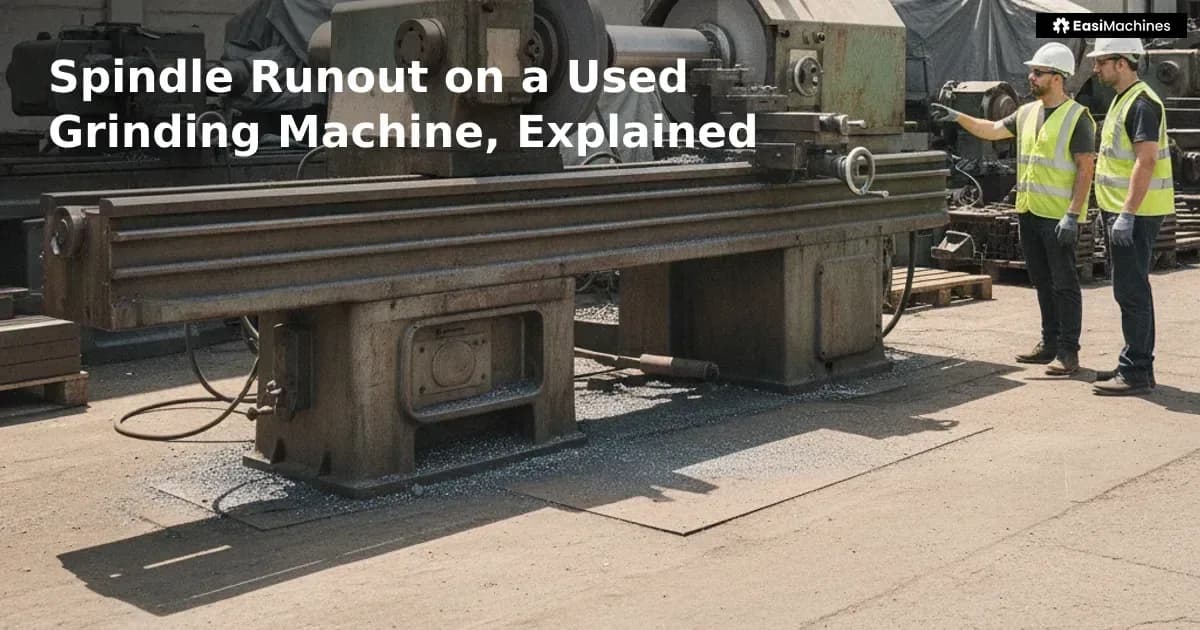
What Spindle Runout Actually Means
Runout is measured as TIR — Total Indicator Reading — the total variation in radial position recorded as the spindle completes one full revolution. A spindle with 0.005 mm TIR deviates by no more than 5 micrometres from its true centreline at any point in its rotation. A spindle with 0.05 mm TIR deviates ten times that amount. The distinction matters because the grinding wheel amplifies runout: a wheel loaded eccentrically cuts deeper on one side of each pass, leaving a surface that looks ground but has a directional waviness the naked eye may not catch until the part is measured.
There are two types worth separating. Radial runout is deviation measured perpendicular to the spindle axis — it affects the concentricity of cylindrical work and the flatness of a surface grinding pass. Axial runout (also called face runout or end-play) is deviation measured along the axis — it affects the face of a wheel and becomes the dominant concern on face-grinding and tool-and-cutter operations. Both matter, but for most surface grinders a buyer looks at radial runout first because it has the most direct effect on everyday work.
Accepted tolerances vary by machine class and application. A new general-purpose surface grinder is typically shipped with radial spindle runout under 0.005 mm. A used machine in good working condition should still hold under 0.010–0.015 mm for production work. Beyond 0.020 mm, the machine is still functional for roughing or non-critical stock removal, but it should not be presented or priced as a precision grinder. Those numbers are a reasonable working reference — the original manufacturer's specification sheet, if available, is the definitive benchmark for the individual machine.
The Causes: Where Runout Comes From on a Used Machine
Spindle bearings are the primary source. Most grinding machine spindles run on precision angular-contact or cylindrical roller bearings that are pre-loaded at the factory to eliminate internal clearance. Years of use, abrasive contamination from wheel dressing, coolant ingress, or a single crash event can introduce play into these bearings or score the races. When that happens, the spindle no longer has a fixed geometric axis — it wanders. Bearing replacement is possible on most machines but is a skilled job requiring a press, proper bearing gauging, and correct pre-load setup; it is not a minor service item.
The spindle taper or nose thread is the second source. If the taper bore that accepts the wheel arbor is worn, dinged, or has been cleaned with an abrasive that left micro-scratches, any wheel mounted there will run eccentrically regardless of bearing condition. Check the taper visually — a worn or repaired taper shows polishing, discolouration, or visible marks around its circumference. A taper in poor condition is a harder repair than bearing replacement because it may require re-grinding the bore in-situ, which is specialist work.
Thermal issues and bent shafts are less common but worth knowing. A machine that has been run without coolant in a sustained grinding pass, or that has seized and been restarted, can develop a thermally warped spindle shaft. A bent shaft produces runout that cannot be corrected by new bearings alone. The tell is that runout measured close to the bearing housing is low, but increases progressively toward the wheel-mount end of the spindle.
How to Assess Runout Without a Dial Indicator
A dial test indicator (DTI) on a magnetic base is the correct tool. If you have one, mount it against the spindle taper bore or the wheel-mount diameter, run the spindle slowly by hand if possible, or use a low-speed jog if the control permits, and read TIR directly. Most buyers inspecting a used machine on-site will not have one. The following checks will not give you a number, but they will identify the machines worth rejecting on the spot and narrow the field to those that warrant a proper measurement before purchase.
- Listen at idle: a grinding spindle at operating speed should produce a steady, even tone. A cyclic whine, intermittent rumble, or variation in pitch that repeats once per revolution points to a damaged bearing or a wheel running out of balance due to eccentric mounting.
- Feel for heat after a short run: spindle housings run warm, not hot. If the housing is uncomfortably hot to touch within 10–15 minutes of light operation, the bearing pre-load is likely incorrect or a bearing is failing.
- Check end-play manually: with the machine off and wheel removed, grip the spindle nose or arbor with both hands and try to push it in and out along its axis. Any detectable axial movement — anything you can feel, not just measure — indicates bearing pre-load loss.
- Inspect the wheel arbor taper and flange faces: scoring, rust pitting, or bright wear marks on the taper or the flange face that contacts the wheel blotter are physical evidence that wheel seating has been imprecise, which both causes and indicates runout.
- Ask to run a test grind on a flat piece of mild steel: a machine in usable condition should produce a consistent spark pattern across the full wheel width on a light pass. Intermittent sparking, a heavier spark band on one side, or chatter marks on the freshly ground surface are practical signs of runout or wheel balance problems.
- Review maintenance records for bearing replacement dates: spindle bearings on a heavily used production grinder may need replacement after 8,000–12,000 operating hours depending on the machine and coolant practice. If the machine has no records and shows high hours, budget for bearing inspection as a near-term cost.
None of these replaces a proper DTI measurement before you commit to a price. If the machine passes the visual and operational checks, make a DTI reading a condition of final purchase — or negotiate the cost of an independent measurement into the deal before you exchange payment.
Where EasiMachines Helps and Where It Does Not
EasiMachines is a marketplace for listed machinery, not a technical inspection service, so it does not generate certified spindle runout readings for individual machines. No online platform does — this measurement requires physical access to the machine. What EasiMachines assists with is the surrounding decision: the listing search lets you filter used grinding machines by type, capacity, and brand, so you can build a comparison shortlist before travelling to inspect anything. The listing itself is the place to ask the seller, in writing through the platform, for the manufacturer's specification sheet and any available service or bearing replacement records. A seller who cannot or will not provide those documents is giving you useful information about the machine's history.
EasiMachines' automated valuation tool gives a directional price estimate based on machine type, age, and condition rating — it is a reference point for negotiation, not a certified appraisal. If a machine's asking price is well below the estimate and the seller lists no service history, the valuation tool helps you frame the conversation about why you are pricing in the cost of a bearing inspection. That is a practical, honest use of it.
Frequently asked questions
What TIR figure should I insist on before buying a used precision surface grinder?
For work held to tolerances tighter than 0.02 mm, aim for a machine with demonstrated radial spindle runout under 0.010 mm TIR. For general-purpose surface grinding to tolerances in the 0.02–0.05 mm range, under 0.015 mm is a workable threshold. Any figure above 0.020 mm should be reflected in a lower price and acknowledged openly as a limitation. Always compare against the original manufacturer's specification — some older precision grinders were built to tighter standards than modern general-purpose machines.
Can spindle runout be corrected after purchase, or is it a write-off?
It depends on the cause. Worn or pre-load-lost bearings can be replaced on most machines, and a skilled rebuild will restore the spindle to close to its original specification. A damaged taper bore can sometimes be re-ground in-situ. A bent or thermally warped spindle shaft is a much harder problem — repair is possible but expensive, and on an older machine the economics rarely work. Get a diagnosis from a machine tool service engineer before buying a machine with confirmed high runout, not after.
Does the brand of grinding wheel affect how runout reads?
The wheel itself does not cause spindle runout, but an out-of-balance or poorly mounted wheel will add to the apparent vibration and surface finish problem in a way that mimics runout. Always dress a wheel correctly before measuring spindle runout — an undressed wheel produces a misleading result. The DTI measurement for runout is taken on the spindle taper or the arbor, not on the wheel face, so the wheel is not in contact during the measurement.
Is spindle runout the same problem on a cylindrical grinder as on a surface grinder?
The physics is the same, but the consequence differs. On a surface grinder, runout primarily affects flatness and surface texture. On a cylindrical grinder — which produces round workpieces to a diameter tolerance — radial runout directly determines how round and how accurately sized the finished part is. Tolerance requirements on cylindrical work are often tighter, so acceptable runout thresholds are correspondingly lower, sometimes under 0.003–0.005 mm TIR on a quality production machine.
Should a seller disclose spindle runout in a used machinery listing?
Ideally, yes — and a seller who has measured it and can quote a figure is giving a strong signal that the machine has been maintained with care. In practice, many sellers do not have the measurement. The honest approach is to state the machine's age, hours, and bearing history, and to allow a pre-purchase inspection. Listing a machine as 'precision' or 'tight tolerance' without any supporting measurement is a claim a buyer should push back on directly before travelling to inspect.