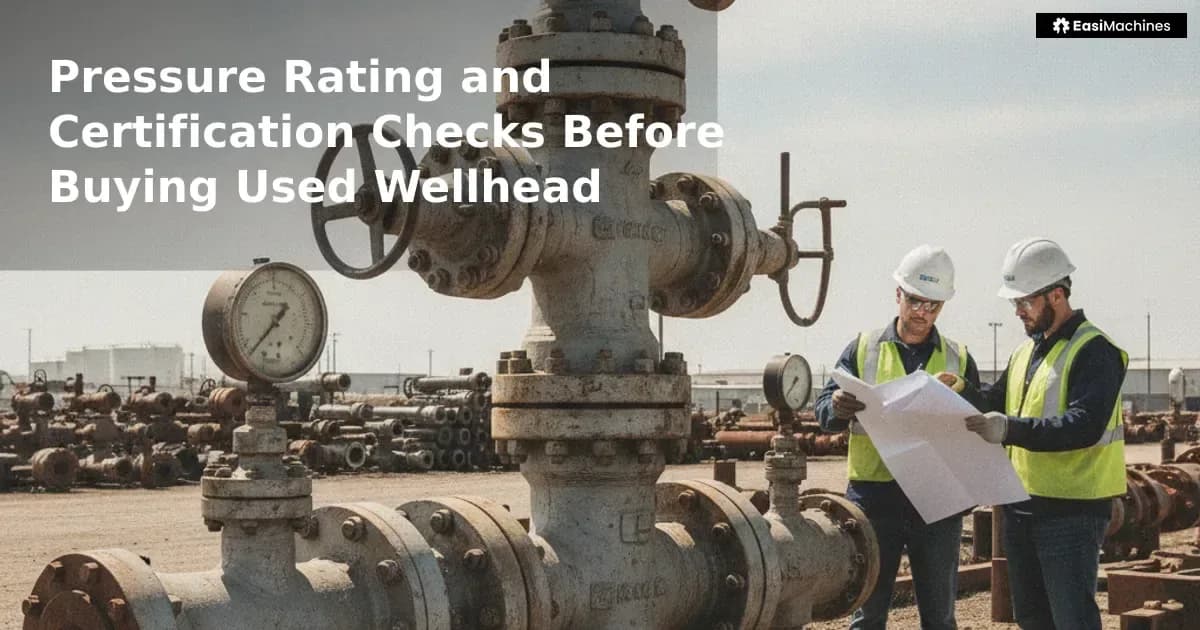
Understand the Pressure-Rating System Before You Read Any Document
The dominant international standard for wellhead and Christmas tree equipment is API 6A (Specification for Wellhead and Christmas Tree Equipment), published by the American Petroleum Institute. It defines pressure classes in pounds per square inch (psi): 2,000 / 3,000 / 5,000 / 10,000 / 15,000 / 20,000 psi. Each class governs the wall thicknesses, materials, testing requirements, and temperature ratings of the component. Equipment manufactured to this standard carries a monogram — a stamp on the body of the component indicating the rated working pressure (WP), the material class, the temperature rating (PR1 or PR2), and the product specification level (PSL 1 through PSL 4, where PSL 4 is the most stringent, required for sour-gas and high-pressure wells).
When you are looking at a used piece of wellhead equipment, that monogram is your first check — but it is not your last. The stamp tells you what the component was rated for when it left the manufacturer. It tells you nothing about what happened to it in the field.
The Document Package You Should Request Before Any Price Discussion
A seller who has maintained a piece of wellhead equipment correctly will have these records. A seller who cannot produce them is either the wrong owner to buy from, or is pricing the equipment as scrap-level material — not as fit-for-service wellhead gear. Request all of the following before moving to any inspection or price negotiation:
- Original mill certificates (also called material test reports, or MTRs): These document the steel heat number, chemical composition, and mechanical properties of the material the component was made from. Without an MTR, you cannot confirm the material matches the API 6A class stamped on the body.
- Original manufacturer's documentation package: Should include the purchase order, the quality-control traceability records, and the API 6A product specification level (PSL) data package issued at manufacture.
- Pressure test records: Every API 6A component is hydrostatically tested at manufacture. Field retest records — ideally with dates, test pressures, duration, and the name of the witness or third-party inspector — should also be present for any component that has seen service.
- Service history log: Documents which wells the equipment was run on, the wellbore pressures and fluids it was exposed to (including whether H₂S or CO₂ — sour or corrosive gases — were present), and the total time in service.
- Repair and modification records: Any weld repair, machining, or replacement of pressure-containing components must be documented and, for API 6A equipment, must have been performed by a facility authorized to maintain the monogram. Undocumented weld repairs are a disqualifying condition.
- Last inspection report: A current third-party inspection report — dimensional checks, non-destructive examination (NDE) such as ultrasonic testing or magnetic particle inspection of pressure-containing walls and sealing surfaces — is the only way to know the present condition of internal surfaces you cannot see.
If the seller has all of the above, you have a starting point for evaluation. If any item is missing, treat it as a gap you must close — through a new third-party inspection, through a reduced price that reflects the equipment being sold without traceability, or by walking away. There is no category of wellhead equipment where the documentation gap is safely ignorable.
The Physical Checks That Documents Cannot Replace
Documentation and physical condition are two separate questions. Equipment can have a complete paper trail and still be unserviceable. Commission a qualified wellhead inspector — not a general mechanical inspector — to check the following before you commit:
- Ring groove condition: API 6A flanges seal using a metal ring gasket seated in a precision-machined ring groove. Measure groove depth and width against API 6A dimensional tolerances; any pitting, corrosion, or scoring in the sealing surface that exceeds the tolerance band means the flange face requires remachining or the component is unserviceable.
- Bore wall thickness: Ultrasonic thickness testing (UT) of the main bore measures remaining wall thickness against the original minimum wall specified by API 6A for the rated pressure class. A component that has lost wall thickness through corrosion may no longer hold its rated WP — and there is no visual way to detect this without UT.
- Valve function and seat integrity: Gate valves (the primary isolation valve type in wellhead assemblies) should operate through full open-to-close travel with no binding. Conduct a seat leak test to verify the valve holds pressure in both directions. A valve that passes in one direction and bypasses in the other is not fit for well-control service.
- Actuator and stem condition (for actuated valves): Check stem straightness, packing gland condition, and actuator function if the valve is hydraulically or pneumatically operated. Bent or scored stems are a common point of failure on wellheads that have seen workover loads.
- Sour-service markings for H₂S wells: Equipment intended for sour service (wells containing hydrogen sulfide, H₂S) must be manufactured from materials meeting NACE MR0175 / ISO 15156 requirements. This is separate from the API 6A pressure class. Confirm that the material certificates and API documentation explicitly state sour-service compliance before running this equipment anywhere H₂S may be present.
Where EasiMachines Helps and Where It Does Not
EasiMachines is an industrial equipment marketplace where sellers list wellhead equipment — spools, trees, valves, and associated pressure-control components — and buyers can search, contact sellers directly, and compare listings. For a buyer starting a search for used wellhead equipment, the platform helps by putting a range of available inventory in one place, making it easier to identify sellers and initiate contact for specification and documentation discussions.
EasiMachines does not currently provide a verified certification document repository, an independent inspection service, or a wellhead-specific compliance check integrated into its listing workflow. The documentation verification process described above — requesting MTRs, service history, inspection reports, and conducting physical third-party inspection — sits outside the platform and must be managed directly between buyer, seller, and an independent inspection firm. EasiMachines assists the search and initial contact stages of a used wellhead transaction; it does not replace the technical due diligence that the equipment category requires.
If you find a wellhead listing on EasiMachines that matches your pressure class and bore size requirements, use the platform to reach the seller, and then apply the document checklist and physical inspection process set out in this guide before any money changes hands.
Frequently asked questions
Can I use wellhead equipment that is rated at a higher pressure class than my well requires?
Generally yes — a higher-rated component is pressure-capable at lower working pressures, and operators sometimes do this deliberately for future well interventions or recompletions. The practical issues are cost, weight, and flange compatibility: higher-class flanges have larger bolt circles and different ring-groove profiles, so mixing pressure classes across an assembly creates a flange mismatch. Verify that every mating connection in the assembly is the same pressure class before assuming a higher-rated component will fit.
What does it mean if a wellhead component has no API 6A monogram?
It means the component was either manufactured before API 6A monogram requirements applied to that category, manufactured to a different standard (some national standards exist), or manufactured without any third-party quality surveillance. Non-monogrammed equipment is not automatically unfit for service, but it requires a substantially higher burden of proof from the seller — original design calculations, material certifications, and an independent engineering assessment — before a competent person can sign off on it for pressure-containing service. Treat the absence of a monogram as a major due-diligence flag, not a minor one.
How do I know if previously repaired wellhead equipment is still fit for service?
The repair must have been performed by a facility holding an API 6A monogram license or by a recognized repair facility operating under a documented quality management system. The repair records must identify the nature of the defect, the repair method, the materials used (with MTRs), and the post-repair pressure test results. After any weld repair to a pressure-containing component, NDE — typically magnetic particle inspection and post-weld heat treatment verification — is required. If the seller cannot produce this specific paper trail for each repair, the equipment should not be treated as rated to its original API 6A class.
Is a hydrostatic pressure test at the point of sale enough to confirm the equipment is safe to use?
A hydrostatic test — pressurizing the equipment with water to a specified multiple of the rated working pressure — confirms that it holds pressure at the moment of the test. It does not reveal wall-thickness loss that hasn't yet caused a leak, crack initiation below the surface, or sealing-surface damage that only manifests under thermal cycling in the field. A hydrostatic test is a necessary part of recommissioning used wellhead equipment, but it should accompany UT thickness testing and NDE inspection, not substitute for them.