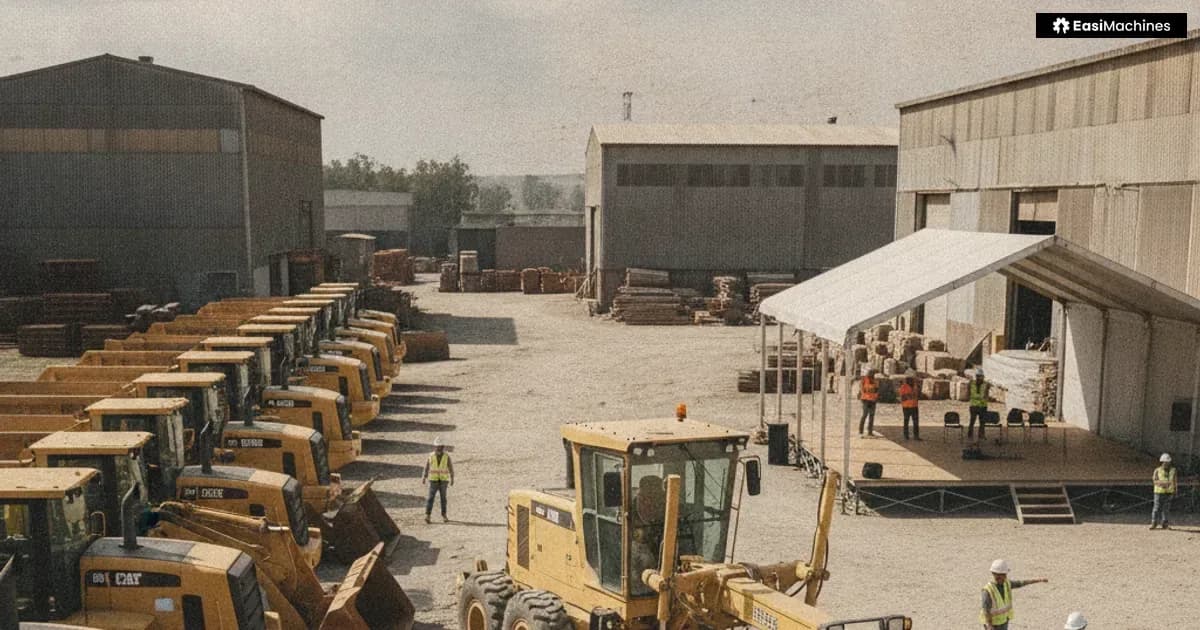
A live auction is an event. You need a venue, access to power and ground space, preview scheduling, on-site security, and a crew capable of moving equipment between lot positions. Buyers travel to you, inspect in person, and bid in a room where competitive atmosphere can push prices past reserve. The auctioneer reads the room and adjusts pace. When two bidders want the same machine, a live setting lets that tension play out fully.
An online timed sale is a documentation exercise. Your asset is the condition report, not the venue. Buyers who cannot attend in person rely entirely on what you publish: photographs, video walkarounds, service records, hour and meter readings, known defects, and any third-party inspection reports. The bidding window runs for hours or days; competitive momentum comes from automated extensions, not a room. Your operational effort shifts from logistics to content production and buyer support.
Documentation gaps become disputes
In an online sale, any condition detail you omit is a potential dispute after the hammer falls. Before committing to a timed format, assess whether your team can produce inspection-grade disclosure for every lot. If the answer is uncertain, a live preview combined with online bidding may reduce that risk.
Live auctions concentrate competitive pressure into a single moment. When a room holds four bidders who all want a specific machine, the price climbs in real time and neither party can walk away to reconsider. That dynamic is difficult to replicate online, though it is not impossible. Extended bidding windows, sniping-prevention extensions, and reserve strategies can maintain tension in a timed sale, but only if the buyer pool is large enough to generate competing bids.
Online formats tend to produce more predictable, market-reflective prices on commodity lots—standard skid steers, common forklift models, utility vehicles—where buyers know the asset well and condition disclosure is straightforward. Live formats more reliably extract premium prices on unusual, specialized, or technically complex machinery where buyers want to evaluate before committing, and where scarcity creates urgency.
Thin lots are a particular risk online. If a timed sale carries only a handful of niche machines and your registered bidder pool for that category is small, you may see a single bid at or near reserve. The live format, by contrast, lets you gauge room interest in real time and make tactical decisions—rearranging lot order, withdrawing a lot, or working the floor—that simply are not available once a timed window opens.
Buyer reach and geography: mapping your actual pool
Before selecting a format, pull your buyer registration data for similar past lots. Where did registered bidders come from, and where did winning bidders come from? If a significant share of your successful buyers are more than a few hours' drive from your yard, a live-only format is already excluding them. That is a structural limit on price realization, not a temporary one.
Online timed bidding removes the travel barrier entirely. It opens your lot to buyers in other regions or countries who would never attend a live event but will bid competitively if they trust your condition disclosure. This matters most for specialized equipment with a narrow global buyer pool—a particular crane configuration, a printing press, a specialist processing line—where the three or four most motivated buyers may be on different continents.
Live formats still have an advantage in markets where buyer density is genuinely high within a manageable radius. General construction equipment in a region with active infrastructure development, or agricultural machinery at the end of a growing season in a farming region, can draw strong rooms. In those cases, live competitive energy may exceed what a timed platform delivers.
Simulcast as a middle path
A simulcast sale runs a live event and a simultaneous online bidding channel. It preserves floor energy for local buyers while extending reach to remote ones. The operational overhead is higher—you need a platform, a camera crew, and a moderator managing both channels—but for high-value lots with a mixed buyer pool it can outperform either format alone.
Inspection complexity: the factor most auctioneers underweight
Inspection complexity is the factor that most consistently determines whether an online format will work. Ask yourself: can a competent buyer make a confident bidding decision from photographs, video, and a written condition report? For a straightforward wheeled loader or a standard diesel generator, the answer is usually yes, provided you cover hour meter readings, hydraulic condition, tyre wear, and any known defects. For a multi-axis CNC machining centre, a specialist crane, or a processing line with proprietary software, the answer is often no.
Complex equipment has failure modes that are not visible in photographs—vibration signatures, calibration drift, software faults, bearing wear that only shows under load. Buyers who know the asset class well enough to pay serious money for it also know what they cannot assess remotely. Without an in-person preview or a credentialed third-party inspection report, they either bid conservatively to price in the unknown, or they do not bid at all.
If you are running an online sale for complex machinery, commission a third-party inspection and publish the full report with the listing. Pair it with a structured video walkthrough that covers operating sequences, not just static views. Use the printable pre-purchase screening checklist at <a href="/resources/inspection-checklist">/resources/inspection-checklist</a> to confirm you have covered the category-specific points buyers will expect. That level of disclosure narrows the gap between online and live, though it rarely closes it entirely.
Online timed bidding vs. live auction: key operational and commercial differences| Factor | Online Timed Bidding | Live Auction |
|---|
| Buyer geography | Global reach; travel barrier removed | Limited to buyers within practical travel distance |
| Price discovery | Market-reflective on commodity lots; thinner on niche lots with small bidder pools | Strong competitive tension when room density is high; real-time auctioneer control |
| Inspection access | Relies entirely on condition documentation and any arranged previews | Buyers inspect in person; reduces disclosure burden and post-sale disputes |
| Complex machinery | High documentation burden; buyers may underbid or abstain without in-person access | Better suited; hands-on evaluation supports buyer confidence |
| Commodity machinery | Well-suited; buyers know asset class; documentation is straightforward | Suitable but may not justify venue cost if buyer pool is dispersed |
| Competitive dynamics | Momentum depends on bidder pool size and automated extensions |
The decision guide: choose online when / choose live when
Choose online timed bidding when:
- Your registered buyer pool for this category is geographically dispersed, with a meaningful share of past winning bidders more than a day's travel from your site.
- The equipment is a commodity type that buyers in the category can assess competently from photographs, video, hour readings, and a written condition report.
- You have the team capacity—or can commission third parties—to produce inspection-grade documentation for every lot before the window opens.
- The lot volume is large enough that an online platform's reach advantage outweighs the loss of floor competitive pressure.
- You want to reduce venue and logistics cost for a widely distributed inventory.
Choose a live auction when:
- Buyer density within practical travel distance is high enough to fill a competitive room for this equipment category.
- The machinery is technically complex, specialist, or has failure modes that buyers need to evaluate in person before committing.
- The lot contains high-value individual units where the premium from competitive floor tension is likely to exceed venue and logistics cost.
- You are selling equipment whose condition is difficult to convey through documentation alone—unusual configurations, heavy wear patterns, or assets with incomplete service records.
- Your documentation capacity is limited and you cannot produce credible remote condition disclosure within the available timeline.
Consider simulcast when:
- You have a strong local buyer base but also registered remote buyers with a demonstrated history of winning bids.
- The lot includes a mix of commodity and specialist equipment, and a single format would disadvantage some lots.
- The per-lot value justifies the additional platform and crew overhead of running two channels simultaneously.
Before you fix a format, work through three checks. First, review the equipment category against a structured inspection checklist to assess how much an informed buyer needs to see in person versus what documentation can convey. The pre-purchase screening checklist covers category-specific inspection points and gives you a clear picture of the documentation burden for an online sale.
Second, map your historical buyer data for this equipment type. If your records show that a large share of winning bidders came from outside your region in past comparable sales, that is a direct argument for online or simulcast. If they came predominantly from within driving distance, a live format is defensible.
Third, be honest about your team's documentation capacity. An online sale with incomplete condition disclosure is not a risk-managed alternative to a live event—it is a liability. Assign the format your team can execute to the standard buyers in that category expect.
Frequently asked questions
How much documentation is actually enough for an online sale of used construction equipment?
At minimum: current hour meter reading, photographs of all four sides plus the cab interior, engine bay, undercarriage, and any visible wear or damage, a video walkaround with the engine running, and a written list of known defects. For anything over a threshold value or with significant wear, a third-party inspection report materially increases buyer confidence and reduces post-sale disputes. What counts as sufficient varies by equipment type—a compactor has different inspection points than a telescopic handler.
Can we set a live preview period before a timed online sale closes?
Yes, and for technically complex or high-value lots it is advisable. A structured preview window—typically two to four days before the bidding close—gives buyers who are within travel distance the option to inspect in person while remote buyers rely on your documentation. Announce preview dates prominently in the listing. Buyers who attend preview tend to bid more aggressively because their uncertainty is lower.
How do we handle a lot that attracts no bids in an online sale?
A single-bid or no-bid outcome online usually signals one of three things: the reserve was above market, the documentation was insufficient to support buyer confidence, or the registered bidder pool for that category was too small. Before re-running the lot, identify which problem applies. Reducing reserve alone will not fix a documentation or reach problem. Consider whether a live event, a simulcast, or direct outreach to known buyers in the category would serve the lot better.
Does the equipment category affect how an online bidding window should be structured?
Yes. For commodity equipment with an active buyer pool, a shorter window of two to five days can sustain urgency. For specialist or niche equipment where buyers may need time to arrange finance, conduct due diligence, or consult engineers, a longer window of seven to fourteen days gives the buyer pool time to engage. Whatever window you set, automated extensions that add time when a bid arrives in the final minutes are standard practice for preventing last-second sniping from suppressing the final price.