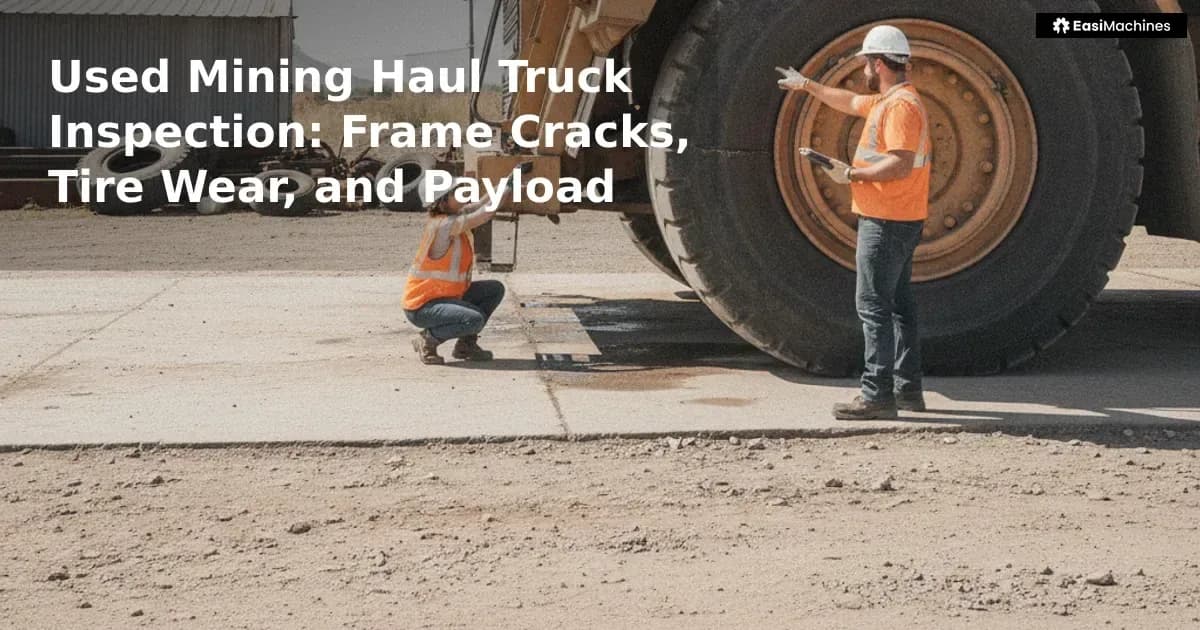
Frame and Structural Inspection: Where to Look and What You Are Seeing
The main frame on a rigid haul truck is a fabricated steel box-section structure designed to flex within controlled limits under load. Cracks propagate when those limits are exceeded repeatedly — through overloading, fast cornering under payload, or aggressive dumping where the body drops rather than lowers onto the frame. Before anything else, clean the frame. Inspecting through a layer of compacted mine dirt is not inspection; it is guesswork. Pay particular attention to four zones: the front cross-member where the steering cylinder mounts, the body pivot-pin brackets at the rear, the suspension saddle pads (the machined seats where the suspension cylinders locate), and the canopy-to-frame connection above the cab.
Cracks in a haul truck frame almost always initiate at weld toes — the edge where a weld bead meets the parent steel — and at re-entrant corners (inside corners where geometry creates stress concentration). Use a bright light and, where access allows, dye-penetrant testing (a simple liquid dye that seeps into surface cracks invisible to the eye, then shows up under a developer spray). A magnetic particle test (MPI) is the better option on ferrous steel and can reveal subsurface cracks. Both tests can be field-applied by a qualified NDT (non-destructive testing) technician and are standard in any serious pre-purchase inspection on a machine in this price bracket. A seller who resists access for NDT testing is telling you something.
Pre-existing weld repairs are not automatically disqualifying — quality repair welds on a cleaned and properly prepared surface, ground flush and re-tested, can restore full structural integrity. The concern is undisclosed repairs, repairs with poor profile (weld ripple sitting proud of the parent metal without grinding, which creates new stress risers), and repairs stacked on previous repairs. Photograph every repair area, note its location precisely, and factor recurrence risk into your offer.
Tire Inspection: Reading Wear as a Proxy for Operating Conditions
Haul truck tires are among the highest unit-cost wear items in mining, and their wear pattern is a direct record of how the machine was operated. OTR (off-the-road) tires on a rigid haul truck should wear evenly across the tread face. Shoulder wear — concentrated on the outer edges — indicates the truck was consistently cornering under load or running on a cambered haul road at speed. Centre wear indicates chronic overloading, which over-inflates the contact patch and concentrates load on the centreline. Sidewall damage — cuts, chunks, or bruising — points to poor haul road maintenance, sharp underfoot material, or berm strikes.
Check tread depth with a dedicated OTR tread depth gauge. Most manufacturers specify a scrap threshold in the 15–20% remaining tread depth range, but the actual usable life depends heavily on the compound and the specific haul road conditions — get the OEM specification for the tire size and compound fitted. More important than the current depth is the rate of wear: ask for the date each tire was fitted and the hours accumulated since. A tire losing depth faster than the compound is rated for is evidence of haul road conditions, loading, or speed that will repeat on the next set.
- Check all six wheel positions (on a standard dual-rear haul truck) individually — inner and outer rear tires wear differently because the outer carries more cornering load.
- Inspect bead seats for corrosion or deformation; a damaged bead seat on a large OTR rim requires rim replacement, not just a tire swap.
- Look for heat discolouration around the valve stem area, which can indicate chronic under-inflation events causing internal heat damage not visible externally.
- Ask whether TPMS (tire pressure monitoring system) data is available — a machine with logged TPMS history gives you a direct record of how consistently the tires were maintained at spec.
- Factor full replacement cost for all six positions at current OTR pricing into your total acquisition budget if tires are at or near the scrap threshold.
Payload and Duty-Cycle History: The Record That Hours Cannot Replace
Every modern haul truck's onboard payload monitoring system (TPMS or a dedicated payload meter, sometimes called PLM — Payload Management System) logs every cycle: tonnes carried, number of cycles per shift, peak loads, and in many cases dump body position during travel. This data is the equivalent of a truck's working biography. A machine that averaged its rated payload over its life has experienced designed stress levels. One that routinely ran at 110–120% of rated payload — common on sites with aggressive production targets and loose load management — has been accumulating fatigue damage in the frame, the suspension, and the drivetrain at a rate the hour meter does not capture.
Request the full PLM export or equivalent payload log covering as much of the machine's operating life as the seller can provide. Look at average payload per cycle, the percentage of cycles above rated payload, and the total equivalent payload tonnes (sometimes called TKPH — tonnes-kilometres per hour, a composite stress figure used by tire manufacturers but also a useful proxy for overall duty severity). A machine that has moved significantly more total material per hour than its rating assumes has a structurally harder life regardless of what the clock says.
Duty cycle matters beyond just load weight. Ramp grade, haul distance, number of cycles per shift, and surface condition all determine how hard the drivetrain, brakes, and retarder system work. A truck running 12% downhill grades under full payload uses its retarder (the system that converts kinetic energy to heat to slow the truck without burning the service brakes) far more intensively than one on a flat circuit. Retarder overuse generates heat that degrades transmission fluid and stresses the hydraulic retarder housing. Ask what grade profiles the machine ran. If the seller cannot answer, treat it as a flag and inspect the retarder housing, transmission, and transmission fluid condition accordingly.
Drivetrain and Suspension Checks That Follow from the Above
Once you understand the payload and duty history, you know which systems to probe hardest. On a high-grade, high-payload machine, prioritise the rear axle housing for cracks at the differential carrier mount, the transmission for oil contamination (a sign of cooler failure or clutch material breakdown), and the suspension cylinders — the nitrogen-oil struts that absorb road shock at each corner. Suspension cylinders should be checked for oil weeping at the seals and measured for ride height with the truck unladen; a collapsed or undercharged cylinder shows as a corner sitting lower than its paired opposite. Recharging cylinders is inexpensive; replacing them is not.
The dump body itself is a structural component. Inspect the floor plate for wear-through (worn to a visibly thin section or already patched with wear liner), the tailgate hinges and pins for wear, and the body pivot pins and bushings at the rear of the frame. Worn pivot pin bores allow the body to shift laterally during dumping, which transfers asymmetric load into the frame — exactly the kind of repeated off-axis stress that initiates cracks at the body pivot brackets mentioned earlier. A new set of pivot pins and bushings is a minor cost; a cracked pivot bracket is a major structural repair.
Where EasiMachines Helps and Where It Does Not
EasiMachines lists used haul trucks from sellers across multiple regions and provides a marketplace path to compare available units by model, configuration, and listed condition — which helps at the identification and shortlisting stage. When you find a machine that matches your operational spec, the platform assists with connecting you to the seller directly so you can request the payload logs, service history, and NDT reports described in this guide.
EasiMachines does not provide independent structural inspection, certified NDT testing, PLM data verification, or mechanical appraisal. No online marketplace can complete those steps for you — they require a qualified technician on-site with the machine. Treat the listing as the start of due diligence, not the end of it. For a machine in the price range a rigid haul truck occupies, the cost of commissioning an independent pre-purchase inspection is a rounding error against the risk of buying unverified structural damage.
Frequently asked questions
How many hours is considered high for a used rigid haul truck?
There is no universal threshold that applies across all models and sizes — a 100-tonne truck and a 300-tonne truck have very different component life expectations, and the same model can have vastly different remaining life at identical hours depending on duty cycle. As a working starting point, many rebuilds of major components (engine, transmission, rear axle) are scheduled in the 15,000–25,000 hour range, but the only reliable way to assess remaining life is to combine the hour reading with the payload log, service records, and a physical inspection. Hours alone are not sufficient.
Can a frame crack on a haul truck be repaired to a serviceable standard?
Yes, with conditions. A properly executed weld repair — parent metal cleaned and preheated to OEM specification, performed by a qualified structural welder, ground flush, and re-tested with NDT — can restore structural integrity at the repair location. The concern is whether the underlying cause of the crack (overloading, suspension fault, poor haul road) has been addressed. A repaired crack that recurs under the same operating conditions is a sign the root cause was not fixed. Require documentation of any frame repair, including the repair procedure and the post-repair NDT result.
The seller says payload logs were lost when the site's system was upgraded. How should I treat this?
With caution, not necessarily as a dealbreaker. PLM data is often stored on the machine's onboard ECU as well as on site servers, so it is worth requesting a direct ECU data download before accepting that the records are genuinely unavailable. If the data genuinely cannot be retrieved, price the machine as if it ran at the harder end of its duty-cycle envelope and weight your physical inspection accordingly — heavier scrutiny on frame, suspension, and drivetrain, and a conservative contingency budget for early component replacement.
Is buying a haul truck with aftermarket wear liners on the dump body floor a red flag?
Not automatically. Fitted wear liners are standard practice on most well-maintained haul trucks carrying abrasive material — they protect the structural floor plate and are cheaper to replace than the plate itself. The flag is a floor plate that has worn through the liner and into the structural steel beneath, or one that has been patched with welded plate rather than replaced. Lift any loose liner sections and inspect the steel underneath. Ask whether liner replacement is tracked in the service record.