What Each Machine Actually Does
A panel saw — either a vertical sliding-table saw or a horizontal beam saw — does one job very well: it cuts full sheets of material (MDF, plywood, melamine, solid timber boards) into parts quickly and to tight dimensional tolerances. A competent operator on a mid-range sliding-table saw can break down a full 2440 × 1220 mm sheet into cabinet carcass parts in under three minutes. The cut is clean, repeatability is high across a full shift, and the learning curve is short. What a panel saw cannot do: it cannot cut curves, rout profiles, drill a pattern of shelf-pin holes, or machine a part in more than two axes.
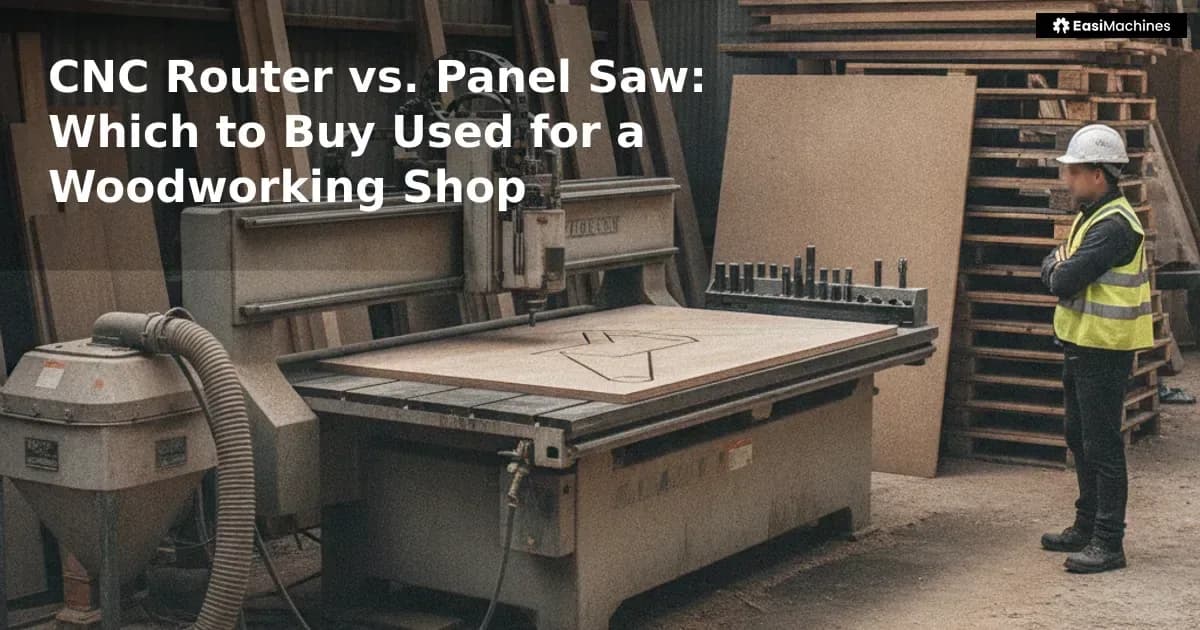
A CNC router (computer numerical control — a machine that moves a motorised cutting tool along pre-programmed X, Y, and Z paths) can cut sheet goods into parts, but it also routes profiles, engraves, drills patterns, and machines complex shapes from a single file. A 4×8 ft (1220 × 2440 mm) flatbed CNC router is the common entry-level format in woodworking shops. It is slower than a panel saw on pure sheet-breakdown work: a nested cutting job — where multiple parts are cut from one sheet in a single machine cycle — typically takes 8–20 minutes per sheet depending on part complexity and tooling. The trade-off is that the sheet comes off the bed already sized, shaped, drilled, and profiled.
The Production Test: Four Questions Before You Buy
No specification comparison replaces this exercise. Answer these four questions honestly about your current or planned workload before you look at a single listing.
- How many sheets do you process per day? Below 10–15 sheets a day, a CNC router's slower cycle time is rarely a constraint. Above 20–25 sheets, a panel saw or a dedicated beam saw becomes hard to argue against for the breakdown stage alone.
- What proportion of your parts are rectangular? If more than 80% of your finished parts are straight-edged rectangles — standard cabinet carcasses, shelving, drawer boxes — a panel saw covers the majority of your cutting. If you regularly make shaped doors, decorative panels, nested furniture, or signage, the router earns its place.
- Do you run repeating jobs or one-off custom work? A panel saw with a programmable fence (a powered stop that moves to preset dimensions) handles repeating rectangular jobs efficiently with minimal setup. A CNC router is strongest when the same file can be reused across multiple orders; one-off intricate jobs are where it genuinely pays for itself.
- Who will operate it? A panel saw can be learned to a safe, productive standard in days. A CNC router requires the operator to work in CAM software (computer-aided manufacturing — translating a design file into machine toolpaths), manage tooling and feeds, and troubleshoot file-to-machine errors. Budget for real training time, typically weeks to months before full productivity.
Buying Used: What to Check on Each Machine
Used Panel Saw
- Sliding table play: push the table laterally at its extended position. Any perceptible side movement indicates worn carriages — a rebuild cost that can exceed the machine's value on cheaper models.
- Fence accuracy: measure a cut part at both ends with a steel rule or digital caliper. A diagonal difference of more than 0.5 mm across a full sheet length indicates a fence alignment or beam issue.
- Blade arbor runout: fit a known-flat blade, clamp a dial indicator to the table, and rotate the arbor by hand. More than 0.1 mm of runout at the tip will produce a visible saw line on finished panels.
- Scoring unit condition (if fitted): the scoring blade — a small secondary blade that pre-cuts the underside of the sheet to prevent breakout — should spin freely, with independent height and width adjustment intact. Worn or seized scoring units are common on older machines and consumable parts can be hard to source for discontinued brands.
- Motor start capacitors and single-to-three-phase conversion: confirm the power supply the machine was wired for matches your shop supply before purchase, not after delivery.
Used CNC Router
- Spindle hours and runout: ask for the spindle hour log if the controller records it. A spindle (the motorised collet that drives the cutting tool) beyond 8,000–12,000 hours on most air-cooled units is approaching rebuild territory. Check runout with a test bar and dial indicator — more than 0.02 mm indicates bearing wear.
- Linear rail and ballscrew condition: move each axis by hand with the machine powered down. Any roughness, stiffness, or backlash (free movement before the axis responds) means worn rails or ballscrews. Replacement on a mid-size machine can run to several thousand dollars.
- Vacuum table hold-down performance: a spoilboard (the sacrificial flat board that covers the table surface) that is heavily machined down reduces vacuum hold — the suction that keeps sheet material flat during cutting. Ask how recently the spoilboard was resurfaced and test hold-down pressure with a sheet of MDF before committing.
- Controller software version and compatibility: older controllers may not accept modern CAM output formats. Confirm the post-processor (the software layer that translates toolpaths into machine-specific code) is available for the software your operators already use or plan to use.
- Dust extraction provision: a router running wood at production speed without adequate dust extraction is both a fire risk and a health hazard. Check that the machine's extraction port size matches what you can connect to — 100 mm, 150 mm, and 200 mm connections are all common and not interchangeable without adapters.
Total Cost Beyond the Purchase Price
A used panel saw has a low ongoing tooling cost. Industrial saw blades suitable for sheet goods cost roughly the same as a reasonable restaurant meal per blade, and a single blade lasts weeks to months of normal use before resharpening. Maintenance is largely mechanical: carriage lubrication, blade changes, fence calibration. Electricity draw is moderate — most single-phase workshop models run on a 3–5 kW motor.
A used CNC router's running costs are higher and less predictable. End mills (the rotating cutting tools used in routing) cost more per unit than saw blades and wear faster, especially on abrasive sheet materials like melamine-faced MDF. A shop doing serious production volume should budget for tooling as a meaningful monthly line item, not a rare expense. The spindle is the highest-stakes component — a rebuild on a quality spindle unit is a significant cost, and a poorly maintained spindle that fails mid-job can damage the workpiece, the table, and the surrounding tooling simultaneously. Power draw is also higher: a 3 kW spindle running at full load, plus servo drives and vacuum pump, puts the total draw of a production router well above most panel saws.
Neither machine is categorically cheaper to run. The router's higher tooling and maintenance costs are offset by its ability to replace multiple other machines — a drill press, a router table, a shaper — that a shop would otherwise need to buy separately. If those machines are already in your shop and paid for, that offset does not apply.
Where EasiMachines Helps — and Where It Does Not
EasiMachines lists used woodworking machinery including CNC routers and panel saws from dealers and private sellers. The search filters allow you to narrow by machine type and country, which helps when you need to compare available stock across sellers in a specific region — useful when your shortlist has already narrowed to one machine category. Listing a machine for sale is also straightforward for sellers who want to reach buyers already searching in this category.
What the marketplace does not replace: an in-person inspection by someone who knows the specific machine model, a test cut on your own material, or a verified service history. Any automated price estimate on a used CNC router or panel saw should be treated as a directional reference — actual condition, controller version, tooling included, and regional supply all shift real value significantly. The decision framework in this guide — the four production questions, the inspection checklist — is work you do before and during the viewing, not something a listing can complete for you.
Frequently asked questions
Can a CNC router replace a panel saw entirely in a small shop?
For low volume shops — under 10 sheets a day — a CNC router running nested sheet jobs can handle most of what a panel saw does, while also doing operations a panel saw cannot. The practical limits are cycle time and operator skill. If you regularly need to break down large quantities of sheet goods quickly, or if your staff cannot run CAM software reliably, a panel saw is faster and simpler for that specific task. Most shops that grow beyond a moderate volume end up running both.
What size CNC router is practical for a small to mid-size woodworking shop?
A 4×8 ft (1220 × 2440 mm) bed is the standard entry point for woodworking shops because it matches the full sheet size of common panel materials. Smaller beds (2×4 ft or 4×4 ft) are cheaper to buy used but limit you to half-sheet or quarter-sheet work, which creates a manual sheet-cutting step before every router job. For cabinet, furniture, or sign work at any meaningful volume, the 4×8 format is the practical minimum.
How do I check whether a used panel saw's sliding table is still accurate?
Make two cuts: one with the sheet fed in the standard direction, one with the sheet flipped end-for-end and re-cut. If the resulting parts are not parallel — measure with calipers at both ends — the sliding table has alignment drift or worn carriages. Also check that the table returns to exactly the same position after being extended and retracted; mark a reference point with a scribe and measure any shift.
What spindle power is enough for production woodworking on a CNC router?
For cutting 18 mm MDF or plywood at production speeds, a 3 kW spindle is a working minimum. A 4–6 kW spindle gives more headroom for larger-diameter tooling, harder materials, and heavier passes without stalling. Be cautious of used machines with spindles under 2.2 kW being described as production-ready — they can handle light work and signage but will be a constraint on full-sheet cabinet parts cut at real throughput speeds.
Is a beam saw better than a sliding-table panel saw for sheet breakdown?
A horizontal beam saw — where the material is stationary and the saw head travels along a fixed beam — is faster and more consistent for pure sheet-breakdown volume than a sliding-table saw. It is also larger, heavier, and significantly more expensive to buy used. For a shop processing fewer than 30–40 sheets per day, a quality used sliding-table saw is the more practical choice. A beam saw makes sense when sheet-breakdown speed is the single biggest production constraint and floor space is not.