What is each engine type, and how does it fit the boat?
An inboard engine sits inside the hull, usually amidships or forward of the transom. The drivetrain passes through the hull via a shaft log (the reinforced tube through the hull through which the propeller shaft passes) and a stuffing box (the seal where that shaft exits the hull) to a fixed propeller. Sterndrive units—also called inboard/outboard or I/O—have the engine block inside the hull and a drive leg with propeller outside the transom that can tilt and pivot for steering. The engine block is inside the hull as with a shaft-drive inboard, but the external drive leg handles steering and trim. Sterndrives suit mid-size planing hulls where cockpit space and steering response matter but transom space for outboards is limited.
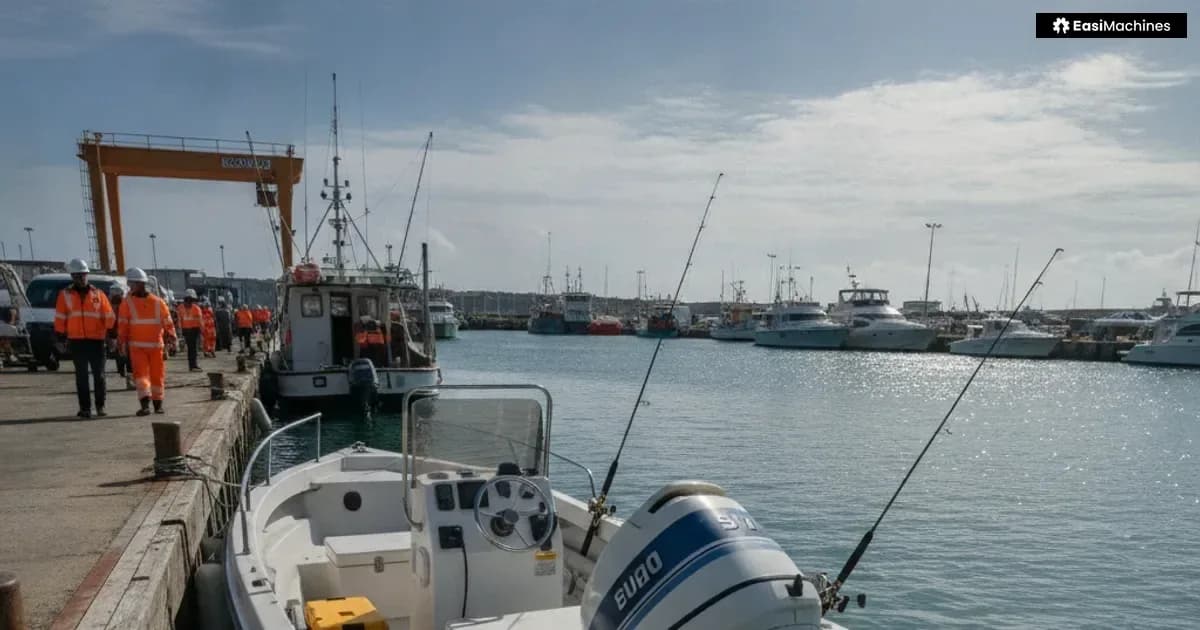
An outboard is a self-contained unit clamped or bolted to the transom. It carries the engine, gearbox, and propeller in one assembly that pivots for steering and tilts clear of the water when not in use. Because the entire unit mounts externally, the hull needs no shaft penetration and the installation is comparatively straightforward.
Hull design locks in the choice
A hull built for an inboard has reinforced engine beds, a shaft log, and a keel cooler (an external heat exchanger mounted to the hull) or raw-water intake in fixed positions. A hull built for outboards has a reinforced transom and an open stern. These are not minor differences. Before you evaluate engines, confirm what the hull was designed to carry.
How do they compare across the key buying criteria?
Inboard vs. outboard engine: head-to-head comparison| Criterion | Inboard (shaft-drive and sterndrive) | Outboard |
|---|
| Hull compatibility | Requires engine beds, shaft log, and hull penetration. Suits displacement and planing hulls built to spec. Sterndrive suits mid-size planing hulls specifically. | Requires a reinforced transom. Suits open boats, centre consoles, and purpose-built outboard hulls. |
| Cockpit and deck space | Engine occupies internal space (bilge or engine room). Cockpit is fully open. | Transom-mounted unit takes no interior space but narrows the stern working area. |
| Weight distribution | Engine weight is low and central, which benefits handling on larger vessels. | Weight is at the stern. Multiple outboards increase transom load; hull must be rated for it. |
| Shallow-water operation | Fixed keel and shaft limit minimum draft. Risk of grounding in shallow water. | Tilts up fully, allowing operation in very shallow water—a genuine advantage for coastal and estuary use. |
| Maintenance access | Engine is below decks; access varies by design. Some installations require removing sole boards or panels. | Engine tilts up and is fully external. Most service points are accessible without tools to reach them. |
| Typical service tasks (owner) | Oil changes, impeller, belts, zincs, stuffing box inspection. Shaft seal and cutlass bearing need a haul-out. | Oil changes, impeller, spark plugs, gear oil, zincs. Many tasks can be done without a haul-out. |
| Fuel efficiency — diesel shaft-drive inboard | Generally more fuel-efficient at cruise speeds on displacement hulls due to lower specific fuel consumption at steady RPM. Best suited to long-passage, low-to-mid-speed operation. | — |
| Fuel efficiency — sterndrive / petrol inboard | Petrol sterndrives are less efficient than diesel shaft-drives and broadly comparable to petrol outboards at planing speeds. Modern four-stroke outboards often match or exceed them at mid-range RPM. | Four-stroke outboards are fuel-efficient across a wide speed range and can match or exceed petrol sterndrive efficiency on planing hulls. Efficiency drops at high load on larger rigs with multiple engines. |
| Annual running cost | Compulsory haul-out for shaft seal, cutlass bearing, and antifouling work adds to annual cost. Labour rates for below-decks work are higher. Budget separately for yard time. | Many routine tasks—impeller, oil, gear oil, plug replacement—can be done on a trailer or at the dock without a haul-out, reducing yard time. Haul-out is still needed for hull antifouling but not for most drivetrain service. |
| Repairability at sea | Major repair usually requires a yard. Partial failures (overheating, alternator) can sometimes be managed underway. | On twin-outboard rigs, one engine can get you home. Outboards are easier to swap off the transom entirely if a replacement is sourced. |
| Service life at high utilisation | Diesel inboards generally achieve longer intervals between major overhaul, particularly in commercial or continuous-use contexts. This is a meaningful advantage for liveaboard or charter use. | Outboard powerheads typically require rebuild or replacement sooner under hard, high-hour use. Maintenance discipline has a large effect on how long a powerhead lasts. |
| Resale and market depth | Strong demand for well-maintained diesel inboards on larger vessels. Specialist buyers. | Very active resale market. Outboards are easier to value and move independently of the boat. |
| Upfront cost (used) | Inboard diesels on larger vessels carry higher unit prices but the engine is part of the vessel sale. Repowering is a large separate cost. | Outboards trade as standalone units with active pricing. Used outboards are widely available across a range of power ratings. |
What to inspect before you buy either type
Engine type does not change the fundamentals of a used marine engine inspection, but it does change where you look and what you can reach. If you are not confident performing these checks yourself, a qualified marine surveyor can conduct a full condition survey before purchase.
Inboard inspection points
- Check the engine logs or hour meter and cross-reference against visible wear on belts, hoses, and injectors. Diesel inboards typically have a documented service interval for injectors, heat exchanger cores (the internal component that transfers heat between cooling circuits), and impellers—ask for the service record.
- Inspect the stuffing box. The acceptable drip rate for a traditional stuffing box depends on the packing material and the manufacturer's or installer's specification—if unknown, consult a marine engineer rather than applying a general figure. A completely dry traditional flax-packing stuffing box may be over-tightened, while one dripping heavily is a haul-out job. Dripless mechanical seals (such as PSS-type designs) are engineered to run completely dry; do not apply the drip standard to them. Identify which type is fitted before drawing any conclusion.
- Check the cutlass bearing (the water-lubricated bearing that supports the shaft near the propeller). This check requires the vessel to be out of the water and the propeller removed to allow free shaft movement. With those conditions met, push and pull the shaft radially at the bearing location; perceptible play indicates wear. Coupling disconnection for a more precise measurement should be carried out by a qualified marine engineer who can re-align the drivetrain afterwards.
- Check the raw-water impeller replacement date. On many inboards this is an annual or biennial task; an unknown interval is a risk.
- Start the engine cold. Watch the exhaust for black smoke (over-fuelling or worn injectors) or white smoke that persists beyond a brief warm-up (coolant in the combustion chamber).
- Inspect the bilge under and around the engine for oil, coolant, and fuel staining. Staining that has been cleaned but left a residue ring indicates a recurring leak.
- On sterndrive units, inspect the bellows—the rubber boots around the drive pivot. Cracked or perished bellows admit water into the hull.
Outboard inspection points
- Check the lower unit gear oil. Drain a sample: milky or foamy oil means water ingress through a failed seal, which requires lower unit rebuild.
- Inspect the propeller for dings, missing material, and blade pitch damage. A bent blade causes vibration that shortens bearing life; price a replacement or repair before agreeing a figure.
- Tilt the engine fully and inspect the tilt tube, trim rams, and hydraulic lines for corrosion and fluid leaks.
- Check the anode condition. Anodes deplete over time to protect aluminium and other metals from galvanic corrosion. Zinc anodes are traditional for salt water; magnesium anodes are correct for fresh water. Aluminium anodes are compatible across salt, brackish, and many fresh-water environments and are increasingly preferred in salt water—check local environmental regulations, as zinc anodes are restricted in some jurisdictions. If the fitted anodes are severely depleted or the wrong type for the intended environment, inspect the lower unit and bracket carefully for pitting, and plan to fit the appropriate anodes for your operating conditions.
- Start cold and run to operating temperature. The engine should reach its thermostat temperature smoothly and the tell-tale (the small water stream from the engine that confirms the cooling circuit is flowing) should run steadily. An interrupted or absent tell-tale means the water pump impeller needs attention.
- On carburetted engines, note whether the engine hunts at idle or requires choke to stay running when warm—both indicate carburettor service.
- Ask for compression readings across all cylinders. A cylinder reading notably below the others warrants investigation—consult the manufacturer's service data for the specific engine, since tolerances vary. Uniform readings are reassuring but do not rule out generalised wear; cross-reference absolute figures against manufacturer minimums if the service manual is available.
Sea trial before any purchase
No static inspection substitutes for running the engine under load on the water. Many problems—cavitation, overheating at speed, steering slop on a sterndrive—only appear at operating RPM. If the seller cannot or will not conduct a sea trial, treat that as a material risk.
What sellers should disclose—and why honesty protects them too
Switching propulsion type is expensive enough that a buyer who feels misled has a strong incentive to pursue the matter. Sellers who disclose known issues early are in a far better position than those who do not. Depending on your jurisdiction, disclosure obligations may also carry legal weight; if you are uncertain about your obligations, seek local legal or commercial advice before listing.
For inboard boats, disclose: engine hours, the last service date and what was done, any known leak history, whether the stuffing box or shaft seal has been replaced, and the condition of any sterndrive bellows. If the heat exchanger or injectors are due for service, say so and price accordingly rather than waiting for a survey to find it.
For outboard boats, disclose: the total hours on each engine, any lower unit work, whether the powerhead (the upper engine assembly, excluding the lower unit) has been rebuilt, salt or fresh water history, and the age of the last impeller service. An outboard that has spent its life in salt water and has been properly flushed and fogged (sprayed internally with preservative oil before storage) has a meaningfully different risk profile from one that has not.
If you are listing a used boat or engine, the Listing Completeness panel on each EasiMachines listing shows which details you have provided, helping buyers see at a glance what has been disclosed. Complete listings attract more serious enquiries and reduce back-and-forth. You can list a machine for sale and reach buyers who are already searching by propulsion type and boat category.
Choose inboard when / choose outboard when
Choose an inboard engine when:
- The hull was designed for it. Repowering a purpose-built inboard hull with outboards is a major structural project.
- Your vessel is large enough that cockpit space and weight distribution at the stern would be compromised by outboard mounting.
- You operate primarily offshore or in deep water where tilting the drive clear of the bottom is never a concern.
- Fuel economy over long passages on a displacement hull matters and a diesel inboard's efficiency at steady cruise RPM is a genuine advantage.
- You have access to a qualified marine engineer for scheduled service or are comfortable paying yard rates for work below decks, including compulsory haul-outs for shaft seal and cutlass bearing service.
- Long-term ownership at high utilisation is the plan. A well-maintained diesel inboard on a displacement hull generally offers longer intervals between major overhaul than a comparably used outboard powerhead.
- You are considering a mid-size planing hull where cockpit space and steering response matter: a sterndrive (I/O) gives you inboard packaging with outboard-style trim and tilt, and suits this application well.
Choose an outboard engine when:
- Your boat is a centre console, open fisherman, or any hull designed for transom-mounted power.
- You fish or operate in shallow coastal water, estuaries, or rivers where you need to tilt the engine clear of the bottom.
- You want to handle basic service yourself. Oil changes, impeller, gear oil, and plug replacement on an outboard require basic tools and no haul-out.
- Redundancy matters: twin outboards mean one engine can limp you home. A single inboard failure leaves you dependent on towing.
- You may want to sell or upgrade the engine independently of the boat. Outboards trade as separate assets with an active resale market.
- Your budget is tighter and you are buying used: a used outboard at a given power rating has a wider, more liquid market with more pricing reference points.
How to evaluate real listings
Once you know which configuration fits your hull and use case, the next step is comparing actual machines. Browse marine equipment listings and use the propulsion type filter to narrow results to inboard or outboard configurations. The EasiMachines compare tool puts selected listings side by side so you can read disclosed hours, service history, and asking price on the same screen without toggling between tabs.
If you have a specific configuration in mind and cannot find it listed, a Wanted request lets you describe the engine type, power rating, and condition you need so relevant sellers can respond directly.
Before you commit to a price, the valuation tool gives a directional price range based on the details you enter. If the tool has insufficient data for your specification, it will say so—treat that as a prompt to seek independent appraisal. When it does return a range, treat it as a starting point for further research rather than a definitive market benchmark. For a full picture of what ownership will cost beyond the purchase price, the cost-of-ownership calculator lets you model maintenance, fuel, and haul-out costs over time using your own inputs.
Use the printable pre-purchase screening checklist as a structured prompt before you go to view any machine. It supports, and does not replace, an inspection by a qualified marine surveyor or mechanic.
Frequently asked questions
Can I convert a boat from inboard to outboard power?
It is possible on some hulls, but it is rarely straightforward or cheap. The transom must be rebuilt or reinforced to outboard manufacturer specifications, the shaft log and hull penetration must be sealed, and the steering and fuel systems must be rerouted. On a fibreglass hull, the structural work alone can run to a significant cost. Get a written assessment from a qualified marine boatbuilder before treating conversion as a budget option.
Are four-stroke outboards now as reliable as diesel inboards?
Modern four-stroke outboards are substantially more reliable than two-strokes and have closed the gap with diesel inboards on durability. However, the comparison depends on use: a diesel inboard operating at steady cruise RPM for long passages on a displacement hull is in its efficiency and longevity sweet spot, while an outboard that is frequently run at wide-open throttle in salt water faces different wear patterns. There is also a service-life difference worth noting for buyers planning high-utilisation or liveaboard use—diesel inboards generally achieve longer intervals between major overhaul than outboard powerheads under equivalent heavy use. Maintenance discipline matters more than the technology label, but buyers with a long-term, high-hour use case should factor this in.
How do I check whether an outboard's hours are accurate?
Many modern outboards store run-time data in the engine management system, which a technician can read with a compatible diagnostic tool. For older engines without digital records, cross-reference the stated hours against visible wear on the powerhead, lower unit gear oil condition, and the service history. An engine with low claimed hours but heavily worn paint, corroded fasteners, and no service records deserves scepticism.
What water type (salt vs. fresh) matters for buying used?
Salt water accelerates corrosion on anodes, lower unit housings, electrical connectors, and bracket hardware. An outboard that has been used exclusively in fresh water and stored properly typically shows less corrosion-related wear than a comparably aged salt-water engine. When evaluating a used outboard, ask for location history and inspect the anode condition and all external aluminium surfaces for pitting or white oxidation. Also confirm that the fitted anodes are the correct type for the new operating environment and replace them if not.