


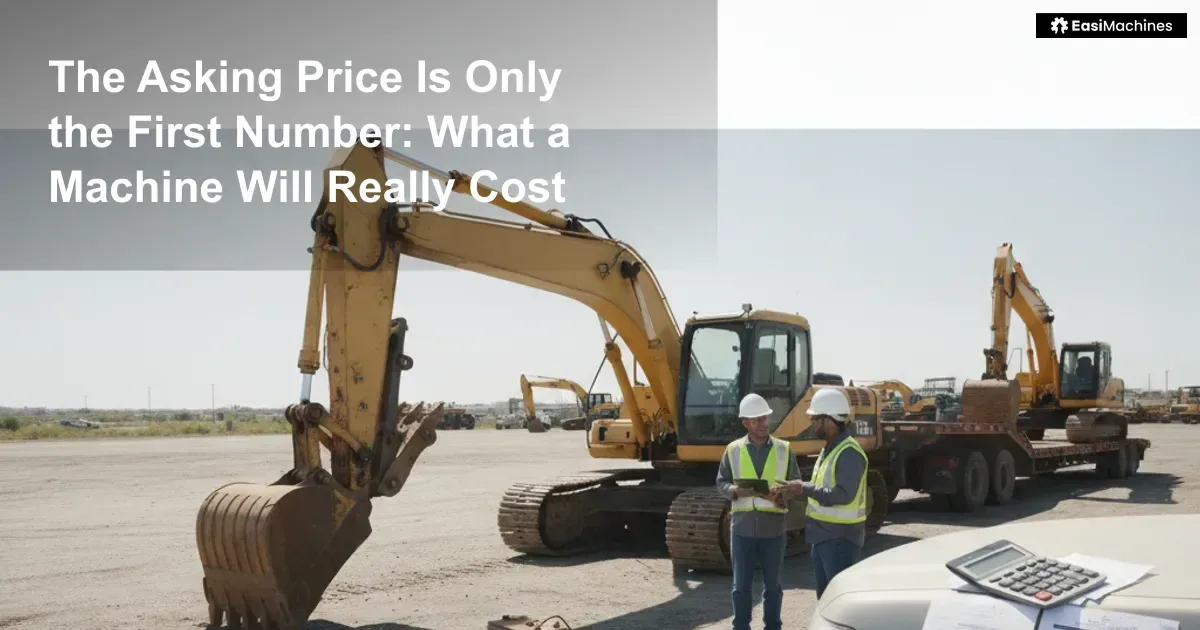
The machine is advertised at a price you can afford. Then come loading, transport, tax, a weak battery, overdue service, tooling, installation and three days when your crew cannot use it. None of those costs were necessarily concealed. They were simply outside the asking price—and that is enough to turn a good-looking deal into a cash-flow problem.
Start with the cost to put it to work
Write one number for the machine and separate numbers for inspection, rigging, freight, insurance, duty or tax, unloading, installation, commissioning, immediate repairs and operator training. If a number is unknown, do not enter zero. Enter a realistic allowance or mark it unresolved.
- Before delivery: inspection, deposit risk, finance, dismantling, loading and transport.
- At arrival: unloading, foundations, power changes, fluids, tooling and commissioning.
- During ownership: energy, labour, service, breakdowns, insurance and downtime.
- At exit: removal, resale value and the time needed to find the next buyer.
A cheap machine can be the expensive option
Two machines doing the same work can have very different costs. The lower-priced one may need a control retrofit or major service. The higher-priced one may arrive with records, familiar parts and local technician support. Compare the cost over the period you expect to own it, not only the amount due this week.
Price uncertainty instead of ignoring it
If you cannot confirm a repair or freight cost, use a cautious range. The unknown belongs in the decision. Removing it from the spreadsheet does not remove it from the deal.
Where EasiMachines helps—and where it does not
The free TCO calculator helps put purchase, finance, maintenance, energy, labour and resale assumptions in one view. For an overseas machine, the import-cost calculator helps estimate freight, duty, tax and clearance. A offers another reference point before negotiation.