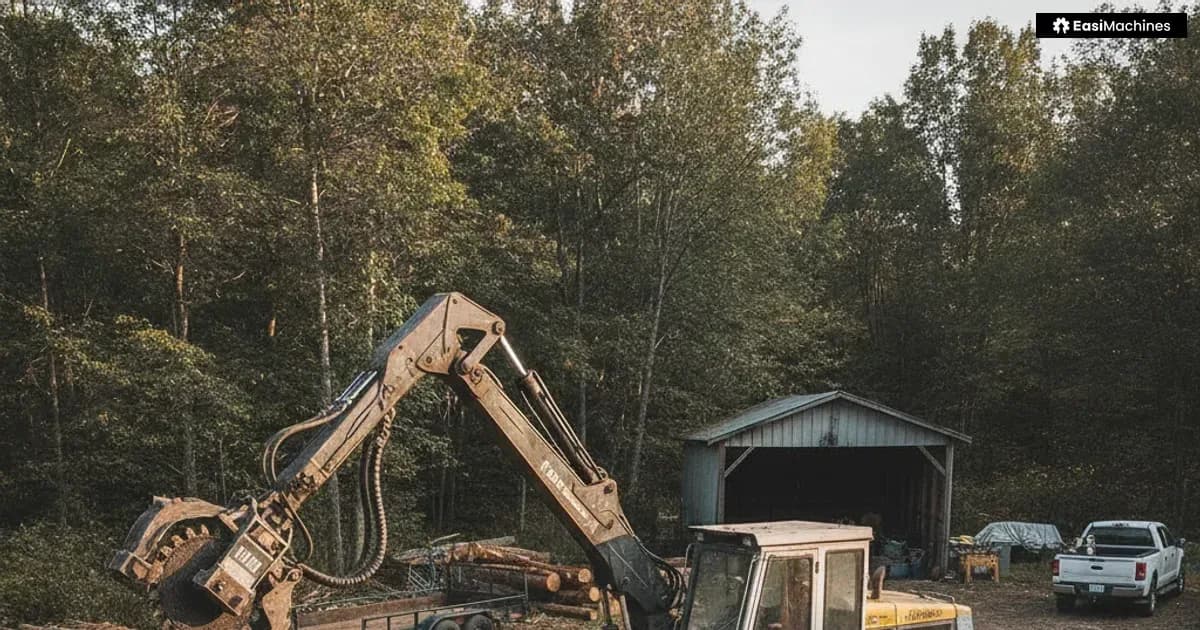
Why Cutting Head Documentation Is Non-Negotiable
The cutting head is the machine's primary wear component and a significant rebuild cost if worn or damaged. Buyers know this and will ask for records whether you volunteer them or not. Providing them upfront signals that the machine has been maintained by people who understood it.
Feller buncher cutting heads fall into two broad categories: disc saw heads and bar-and-chain heads. Disc saw heads use a circular saw disc and include high-torque hot-saw variants designed for large-diameter timber. Bar-and-chain heads use a harvester-style bar and chain mechanism and are more common on smaller or purpose-built machines.
For a disc saw head—including hot-saw variants—document the disc condition and the date of the last disc replacement. For a bar-and-chain head, record bar and chain hours at last change. If the saw head has been rebuilt or the saw motor replaced, include the service invoice: date, supplier, parts used, and hours at time of service. Where the saw tooth pattern matters for the timber species the machine worked in, note that too—buyers re-entering that timber type will see it as a match.
Get the saw head raised on stands or a hoist and shoot it from directly below, so the disc, bar, or chain components are fully visible. A second photo of the saw motor mounting and any visible seals tells a buyer more than a paragraph of description.
Photograph the head at rest, not in action
Static photos with good lighting on a clean, stationary machine show wear detail that action or working photos obscure. Clean the head of debris before shooting.
Hydraulic System Integrity: What Buyers Test and What You Should Document First
Experienced feller buncher buyers will request a hydraulic pressure test before purchase, or they will bring an inspector who performs one. Conducting the test yourself and documenting it before listing means you control the narrative and avoid a renegotiation triggered by a buyer's test that surfaces a surprise you should have disclosed.
Have a qualified hydraulic technician measure system relief pressure against the manufacturer's specified operating range for the machine's model year. Record the result, the date, the technician's name or company, and the hours on the machine at that point. Note the condition of hydraulic filters at last change and the date. If you have a fluid analysis result, include it—it is a useful indicator of wear-metal levels and contamination across the circuit. Fluid analysis is an indicator to be read alongside pressure testing, not a substitute for functional testing of pumps, cylinders, and relief valves.
Cover the hydraulic tank, the main pump and motor block, and every visible hose and fitting in the boom circuit with your camera. Look for staining around fittings and hose ends; clean these areas before shooting, then check again after a brief cycle. Fresh staining after cleaning is a weep you need to disclose, not conceal. Buyers who find concealed leaks on arrival will walk or impose a significant price adjustment.
Disclose known leaks before listing, not during inspection
A minor weep disclosed upfront with a quoted repair cost keeps the deal alive. The same weep discovered by a buyer's mechanic during their visit is treated as a red flag for what else may not have been disclosed, and it often ends the negotiation.
Undercarriage Wear: Measure It, State It, Photograph It
The guidance in this section applies to tracked feller bunchers. For wheeled machines, the relevant checks shift to axles, differentials, gearboxes, and tyre condition—see the FAQ below for detail on wheeled variants.
On a tracked feller buncher, the undercarriage—tracks, rollers, idlers, sprockets, and the carrier frame—represents a substantial rebuild cost when worn. Buyers evaluate undercarriage condition as a direct proxy for remaining productive life and as a basis for price negotiation. Vague descriptions such as 'tracks are in good condition' carry no weight with experienced buyers.
Measure track pad thickness and grouser height and record them. Note sprocket tooth profile: sharp, pointed teeth indicate low wear; rounded or hooked teeth indicate significant hours in abrasive ground. Check the rollers for flat spots and seeping seals, and record any that need attention. If the undercarriage has been assessed by a dealer or independent mechanic, include their written assessment.
Track sag—the centre-span deflection of the track between the sprocket and front idler—reflects current track tension, not wear alone. Sag outside the manufacturer's specified range may simply mean adjustment is overdue, which is a minor maintenance item. Read sag alongside sprocket and roller condition to determine whether the underlying cause is tension or wear. Adjust track tension to the manufacturer's specification before measuring, or note clearly that adjustment has not been performed, so buyers can interpret the reading in context.
Set the machine on a flat, well-lit surface and shoot the undercarriage from both sides. A close photo of the sprocket teeth and a photo of the track in the centre span give buyers the visual confirmation they need to trust your written description.
Undercarriage condition: what to measure and state in the listing| Component | What to Measure or Note | What Buyers Use It For |
|---|
| Track pads | Pad thickness and grouser height (mm) | Estimating remaining track life |
| Sprocket teeth | Profile: sharp / worn / hooked | Gauging overall undercarriage hours in abrasive ground |
| Rollers | Seal condition, flat spot check | Estimating roller replacement cost |
| Idlers | Surface wear, visible cracks | Part of total undercarriage rebuild scope |
| Carrier frame | Visible cracks, bent members, weld repairs | Structural integrity and insurance / financing eligibility |
| Track sag | Centre-span deflection against manufacturer spec, with tension status noted | Whether adjustment or replacement is the required next step |
Cab Safety and Operator Environment: Address Buyer Liability Directly
Logging operations in many jurisdictions require feller buncher cabs to meet falling-object protective structure (FOPS) and rollover protective structure (ROPS) standards. Applicable standards vary by country and certification body—ISO, EN, SAE, and national equivalents each have their own requirements. ISO 8084 is one widely referenced standard for operator protective structures on forestry machinery. A buyer placing this machine with employed operators, or working under a forestry contractor licence, will ask about cab certification before almost anything else. Failing to address this in the listing creates doubt, even if the machine is compliant.
State whether the cab meets the FOPS and ROPS standards applicable to the model year and country of manufacture, and identify the standard by name where possible. Be aware that buyers operating in regulated markets may require compliance verification against the standard current at time of purchase, not only at time of manufacture—particularly if the cab has been modified or repaired since leaving the factory. If the original FOPS certification plate is intact and legible, photograph it. If a cab has been modified or repaired since manufacture, note what was done and whether the work was carried out by a certified structure fabricator.
Beyond certification, list the practical operator comfort features: seat suspension type, climate control status, door seal condition, visibility aids such as cameras, and the condition of controls and armrests. Operator retention is a real concern for logging contractors. A listing that describes a comfortable, well-maintained cab environment speaks directly to that concern and differentiates your machine from one that states only hours and price.
FOPS and ROPS: check the original certification plate
The certification plate on the cab structure typically states the standard under which the FOPS or ROPS was certified. If the plate is missing or damaged, buyers in regulated markets will factor in the cost of a structural re-certification. Disclose this before listing if the plate is absent.
Maintenance Records: Organise Them Before You List
A feller buncher with complete maintenance records is a demonstrably different asset from one with the same hours and no paperwork. Records show that service intervals were followed, that wear items were replaced before they caused secondary damage, and that the machine's history is known rather than assumed.
Compile the engine service records (oil, filters, coolant flushes), saw head service records, and any major repair invoices. If a dealer service network was used, request a printed service history from the dealer before listing. Group records by date and note hours at each service. If there are gaps, state them plainly: buyers who find gaps themselves treat them as concealed neglect; buyers told about gaps upfront can evaluate them in context.
- Gather all paper or digital service records and sort by date.
- Cross-reference dates against machine hour meter readings from telematics or the logbook.
- Identify any gaps and note what you know—or do not know—about those periods.
- Request a dealer-printed service summary if the machine was serviced under a dealer network agreement.
- Scan or photograph physical records and include them as attachments in your listing or make them available on request.
Pricing: How to Arrive at a Defensible Number
Manufacturers and OEM sellers with trade-in or refurbished stock often face the same tension: pricing too high slows enquiries; pricing too low signals something is wrong, or leaves margin on the table. The way to resolve that tension is to price from evidence, not from instinct, and to show that evidence in the listing.
Start with comparable active listings in your region for the same model, year, and configuration. Then adjust for the condition evidence assembled: a machine with documented hydraulic test results, a recent cutting head rebuild, and complete service records is not the same asset as one without those records at the same age and hours. The documentation justifies a price above the bare comparables, and the listing should explain why—not assert it.
The valuation tool on EasiMachines gives a directional price range based on the details you enter; treat it as a reference point alongside your comparables research, not as a certified appraisal. If your machine sits at the top of its price band, the listing content—documentation, photos, disclosed condition—is what supports that position.
Building the Listing: Completeness Converts Enquiries Into Offers
A listing that provides only year, hours, and a price creates buyer uncertainty on every other point. Uncertainty produces low-ball enquiries or silence. A complete listing that answers the questions a logging buyer will ask anyway—cutting head, hydraulics, undercarriage, cab, records—converts more of those enquiries into genuine offers.
When you list your machine on EasiMachines, the AI extraction tool can draft listing details from your photos or a spec sheet; review and correct the draft before publishing. The Listing Completeness panel then shows which fields have been filled and which are still open—use it as a checklist, not a formality. Buyers can see the panel too, and an incomplete listing signals that information is being withheld, whether or not that is the case.
For a used feller buncher, the fields that matter most to qualified buyers are: machine model and configuration, engine hours, saw head type and hours, recent hydraulic service or test result, undercarriage condition description, FOPS/ROPS status, and maintenance record availability. Filling every one of these fields with supporting photos is the single most effective step toward attracting a buyer who is ready to move at your price. Browse current forestry equipment listings to see how comparable machines are being presented and where your listing stands.
Frequently asked questions
Should I have a third-party inspection done before listing a used feller buncher?
A pre-listing inspection by a qualified forestry equipment mechanic or dealer service team adds credibility, particularly for the hydraulic system and undercarriage—the two areas where buyers most often challenge seller-described condition. The inspection report becomes a listing asset. If the inspection surfaces issues, you can address them before listing or disclose them with a repair quote factored into your asking price. Either approach is stronger than a buyer's inspector finding the same issues on arrival.
How many photos should a feller buncher listing include?
There is no fixed number, but cover these views as a minimum: overall machine from both sides and the front, cab interior showing seat and controls, cutting head from below, hydraulic pump and motor block, both sprockets, both sides of the undercarriage, the FOPS/ROPS certification plate, and the hour meter. That is roughly twelve to fifteen photos. Additional close-ups of specific wear points or repaired areas are always worth including. Buyers who cannot see a component will assume the worst about it.
What if service records are incomplete or missing entirely?
Disclose the gap and state what you know. If the machine was acquired as a trade-in and records prior to that date do not exist, say so. If the machine was serviced in-house without paperwork, describe the service regime as clearly as possible and provide current measured condition—hydraulic pressure test, undercarriage measurements, fluid analysis—as substitute evidence. Buyers can work with honesty; they cannot work with uncertainty, and they will price in the worst-case assumption if given no other basis.
Does the machine type—tracked or wheeled—significantly affect what documentation buyers expect?
Yes. Buyers of a wheeled feller buncher will focus on axle condition, differential and gearbox service history, and tyre wear rather than an undercarriage. The undercarriage table and measurement guidance in this article applies to tracked machines only. For a wheeled machine, document tyre tread depth and age, axle seal condition, and any gearbox or differential service records. Buyers purchasing for softwood thinning on firm ground have different wear tolerance than those purchasing for hardwood clear-cutting in wet or rocky terrain—tailor your documentation to the likely work environment.